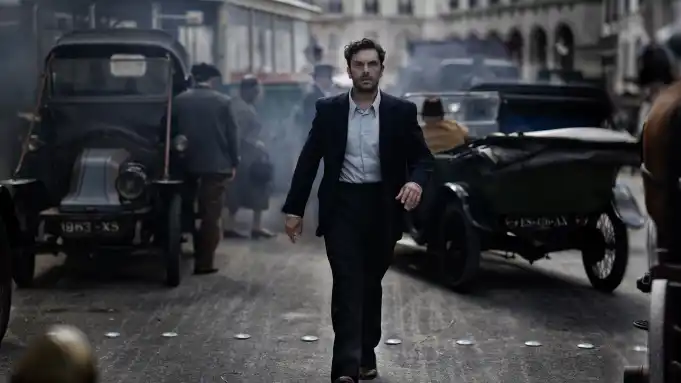
The Cannes Film Festival got underway Tuesday (May 12, 2026) in typical — and very French — fashion with the opening-night film, ‘The Electric Kiss’ (La Venus électrique) . It is a very French romantic comedy of loss, grief, deception and renewed love of life and art.
Premiering out of competition , the 1928 Paris-set charmer comes from veteran filmmaker Pierre Salvadori (After You, Priceless) and serves as a sweetly old-fashioned kind of movie often seen coming from France — a crowd-pleaser that could work nicely for audiences, international and domestic, seeking a little escape from the dark times that will no doubt be portrayed vividly at the festival in the next 11 days.
The Plot: A Carnival Performer, A Grieving Artist, and A Deception
The title refers to Suzanne (played by a terrific Anais Demoustier ), a down-on-her-luck carnival performer who is the attraction that lures men for a kiss that gives off a sharp electric shock (thanks to behind-the-curtain wiring) meant to literally demonstrate the “electricity” of love.
For her, this has become a dead-end job that has made her so desperate that she resorts to petty crime, even attempting to rob from her neighbor, a psychic.



It is there she is actually mistaken for the medium by sad-sack grieving artist Antoine Balestro ( Pio Marmaï ), who has given up his life force and creative inspiration after the death of his wife Irene (Vimala Pons). He has come to this psychic in the hopes of connecting with her from beyond.
Suzanne, seeing perhaps an easy mark, passes herself off as just the person who can grant his wish — and thus begins her phony side hustle.
The Complication: Friend and Manager Discovers the Ruse
Stumbling onto this ruse, Antoine’s friend and manager Armand ( Gilles Lellouche ) immediately can tell Suzanne is a fake and scolds her for exploiting his friend’s grief.
But when he sees that these sessions actually spark Antoine’s painting , he changes his tune. He teams with Suzanne to keep up the disguise in return for a piece of the profits from Antoine’s new works and shows.
It all gets very complicated when current life merges with flashbacks of his past life with Irene and a budding romance with — you guessed it — Suzanne.
Tone: Subtle Comedy, Not French Farce
All of this might seem the recipe for pure French farce, but Salvadori and his co-writers Benjamin Carbit and Benoit Graffin don’t go for obvious comic opportunities, especially with death and grief as underlying themes.
The comedy here is more subtle , and the tone more lushly romantic and human .
The actors are perfectly cast, starting with Marmaï’s likable Antoine, the only player here not being the deceiver. He hits all the right notes, as do the two women in his life — present with Demoustier, and past with Pons, whose role is more developed than the usual case of flashback performances. Lellouche, as usual, is all-pro and winning as Armand.
The Visuals and Music: A Feast for the Senses
A big plus for The Electric Kiss is the visual look of the film , with shout-outs to:
- Julien Poupard (cinematographer)
- Angelo Zamparutti (production designer)
- The wonderful music score from Camille Bazbaz
The film’s lush production design — recreating 1928 Paris — and its evocative cinematography are major selling points.
The Cast in Detail
Anais Demoustier plays Suzanne, the desperate carnival performer turned fake psychic. The review calls her “terrific.”
Pio Marmaï plays Antoine Balestro, the grieving artist who has lost his creative spark after his wife’s death. He is described as “likable” and “hitting all the right notes.”
Gilles Lellouche plays Armand, Antoine’s friend and manager who initially detects Suzanne’s fraud but then sees an opportunity. The review says Lellouche is “all-pro and winning.”
Vimala Pons plays Irene, Antoine’s deceased wife, seen in flashbacks. Her role is “more developed than the usual case of flashback performances.”
Gustave Kervern and Madeleine Baudot also have supporting roles.
Director Pierre Salvadori: A Veteran Filmmaker
Pierre Salvadori is best known for:
- After You (2003) — starring Daniel Auteuil and José Garcia
- Priceless (2006) — starring Audrey Tautou and Gad Elmaleh (a romantic comedy set in the French Riviera)
- In the Courtyard (2014)
- The Trouble with You (2018)
He is known for crowd-pleasing, character-driven comedies with heart. The Electric Kiss fits squarely within his oeuvre.
Cannes Opening-Night Tradition
The Cannes Film Festival opens each year with a high-profile film, usually out of competition. Previous opening-night films include:
- Jeanne du Barry (2023) — starring Johnny Depp
- Final Cut (2022)
- Annette (2021) — directed by Leos Carax
- The Dead Don’t Die (2019) — Jim Jarmusch
The Electric Kiss continues this tradition of crowd-pleasers that set a lighter tone before the more serious competition films.
The 1928 Paris Setting
The film is set in 1928 Paris — the “Années folles” (Crazy Years) period between the two World Wars, known for:
- Artistic ferment (Surrealism, Art Deco)
- Jazz music and cabarets
- Changing social mores
- Economic boom before the Great Depression
This period provides rich visual and cultural material for a romantic comedy — vintage costumes, classic cars, smoky cafés.
Themes: Grief, Deception, and Rebirth
Beneath the charming surface, The Electric Kiss deals with serious themes:
Grief and loss — Antoine cannot move on after his wife’s death. He is literally stuck in the past.
Deception and exploitation — Suzanne pretends to be a psychic, taking advantage of Antoine’s grief. Armand exploits the situation for profit.
Rebirth and renewal — Through this deception, Antoine begins painting again. His art is reborn, even if the means are dishonest.
The film asks: is deception justified if the outcome is positive? Can lies lead to truth?
The ‘Electric’ Metaphor
The title refers to Suzanne’s carnival act — an “electric kiss” that shocks (literally) paying customers.
Metaphorically, the “electric kiss” represents:
- The spark of love (exhilarating but shocking)
- The shock of grief (unexpected and painful)
- The jolt of creative inspiration (coming from unexpected sources)
The film plays with these meanings throughout.
Box Office and Distribution
The Electric Kiss is produced by Philippe Martin and sold internationally by Playtime , a French sales agent.
As an opening-night film at Cannes, it will receive significant press attention, which should boost its international theatrical prospects.
Given its crowd-pleasing nature, it will likely be picked up for distribution in multiple territories (including North America, where French-language films have a niche but loyal audience).
Critical Reception (Based on This Review)
This Deadline review is largely positive :
- “Lushly designed and charming”
- “Sweetly old-fashioned”
- “Crowd-pleaser”
- “Perfectly cast”
- “A big plus is the visual look”
- “May not be ‘electric’ cinema itself, but as a Cannes opener it does the job”
The review notes that the film is not groundbreaking (“not electric cinema itself”) — but as an opening-night film meant to set a pleasant, welcoming tone for a 12-day festival, it succeeds.