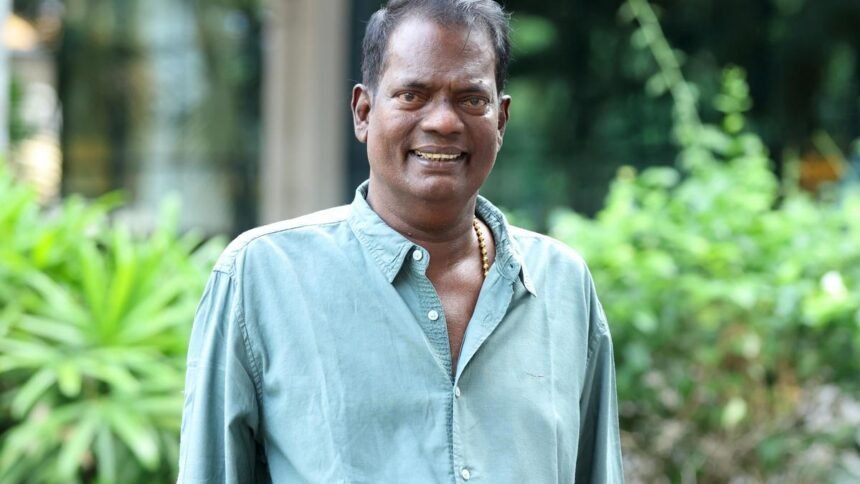
Salim Kumar, who passed away on Saturday at the age of 56, carved an extraordinary path from being a “joke” on stage to becoming a National Award-winning actor and the king of Malayalam internet memes.
His journey, spanning nearly three decades, is a testament to his resilience, his unparalleled comic timing, and his ability to turn even failure into a punchline.
The ‘Comicola’ Days and the Birth of a Meme
In the 1990s, Salim Kumar’s irreverent humor, perfected in mimicry troupes like Cochin Kalabhavan, catapulted him to stardom through the iconic audio cassette series Dhe Maveli Kombathu. He became a household name, a master of political mimicry with a gift for the absurd.
However, his early foray into films was met with a harsh dose of reality. After his memorable turn in Thenkasipattanam (2000), his initial cinematic outings were often met with derision. The audience, accustomed to his manic stage energy, was unforgiving. “He is not funny,” was the common refrain.



In a poignant interview with a regional television channel, Salim Kumar recalled his lowest point: “It was a time when people used to consider me a joke. I used to hear that Salim Kumar is not even a good joker. It was insulting.”
Yet, in a remarkable twist of fate, the 2010s turned those insults into his greatest asset. The rise of social media transformed Salim Kumar into the undisputed meme king of Malayalam cinema. His exaggerated expressions, his distinctive voice, and his unique style of delivery were clipped, shared, and repurposed into thousands of viral memes.
The Dramatic Transformation
The turning point came with director Lal Jose’s Achanurangatha Veedu, which earned him the Kerala State Film Award for Second Best Actor. But the defining moment of his career was his National Award-winning performance as Abu, the attar seller in Adaminte Makan Abu (2010).
His transformation was so profound that he was probably the first to initiate political mimicry, and it was his strong command over imitation that made him a pioneer in the field, according to veteran mimicry artist K.S. Prasad.
The Champion of the Underdog
Salim Kumar never forgot the sting of rejection. In his later years, he became a vocal critic of the industry’s caste bias. He often pointed out how he was considered “ugly” and “unfit” for heroism, a perception that fueled his iconic supporting roles.
“I was always the odd one out. I have never been the kind of comedian who made people laugh at first sight. I earned every laugh. I am proud of it,” he had once said. His triumph was not just over his critics, but over the industry’s stereotypes. He proved that a ‘joker’ could have the last laugh, earning the nation’s highest honor in a career that began with the sound of mocking laughter.
Salim Kumar’s legacy is not just in the films he left behind but in the thousands of memes that will continue to make us laugh. He managed to pull off the ultimate trick—he made us laugh at him, with him, and finally, at ourselves. By turning his own inadequacy into a universal joke, he became the only star who, even in death, remains eternally meme-worthy.