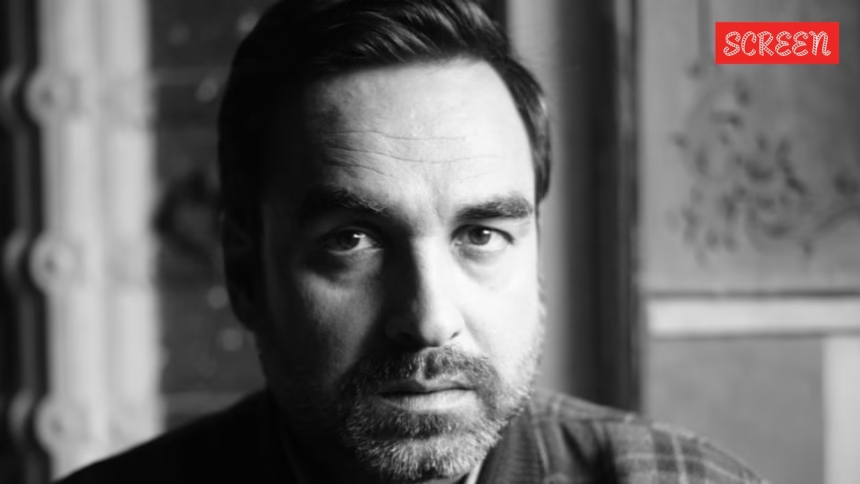
National Award-winning actor Pankaj Tripathi has opened up about the class prejudice he faced early in his career, revealing that people judged him for not being fluent in English and often assumed he came from a background of poverty.
In a candid chat with Hauterrfly, the 49-year-old actor, known for his roles in ‘Gangs of Wasseypur’, ‘Stree’, ‘Luka Chuppi’, and ‘Sacred Games’, spoke about his journey from a small village in Bihar to becoming one of the most respected actors in the country.
‘Unka assumption ye tha ki main gareeb hoon’
“In the initial years, many people judged me because I didn’t speak English. Unka assumption ye tha ki main kisi gareeb ghar se aaya hoon. They assumed I came from poverty,” Tripathi said.
He clarified that he was never poor in the sense of lacking food or shelter. “My father was a farmer. We had food, we had a house. But in Mumbai, if you can’t speak English, people assume you are from the bottom of the economic ladder.”



Tripathi said that the judgment was not just about language but about the assumptions that came with it. “They would look at me and decide — this man is not sophisticated, not educated, not capable. Without even having a conversation with me.”
Language as a marker of class
Tripathi’s revelation has struck a chord with many who have faced similar prejudice in India’s urban, English-speaking professional environments. The actor, who studied in a Hindi-medium school in his village and later graduated from the National School of Drama (NSD), said that the bias against non-English speakers is deeply entrenched in the film industry and beyond.
“At NSD, they taught us that an actor’s instrument is his body, his voice, his emotions. Not his English. But outside, the rules are different. If you can’t speak fluently, you are judged before you even open your mouth.”
He recalled how during his struggling days, he would often be overlooked for roles that required “urban” characters. “They would say, ‘Pankaj ko English aati nahi hai, woh modern role nahi kar sakta.’ But English fluency has nothing to do with acting ability.”
The turning point
Tripathi said that his career took off not when he learned English, but when directors began casting him for his authenticity. Anurag Kashyap, who directed him in ‘Gangs of Wasseypur’, saw something else. “Anurag sir never asked me about my English. He asked me about my village, my childhood, my father’s farm. He wanted my reality, not my polish.”
Since then, Tripathi has become one of the most sought-after character actors in the country, with a filmography that includes critical and commercial hits across Hindi, Marathi, and web content. His performance as Kaleen Bhaiya in ‘Sacred Games’ is considered iconic — and the character spoke Hindi, not English.
‘Sky is the limit now’
Tripathi said that today, he no longer feels the pressure to conform. “Now, I am confident that the sky is the limit for me. Not because I have learned English — I still don’t speak it fluently — but because I have learned to value myself.”
He added that success has brought with it a certain freedom. “I don’t need to prove anything to anyone anymore. I have worked hard, I have earned respect, I have made my family proud. That is enough.”
Advice to young actors
When asked what he would say to young actors from small towns who struggle with the same prejudice, Tripathi was direct: “Apni shaktiyon ko pehchano. Tumhe English nahi aati? Toh kya hua? Tumhari kahaani mein woh kaach hai jo kisi aur ke paas nahi hai. Use gahna banao, bojh nahi.”
He added, “And remember — audience doesn’t watch a film for English. They watch it for emotion. And emotion ki koi bhasha nahi hoti.”
The bottom line
Pankaj Tripathi’s journey from being judged for his lack of English to becoming one of India’s most celebrated actors is a testament to the fact that talent, hard work, and authenticity ultimately speak louder than any language. As he put it: “Main woh hoon jo main hoon. Aur ab main usmein koi kami nahi maanta.”