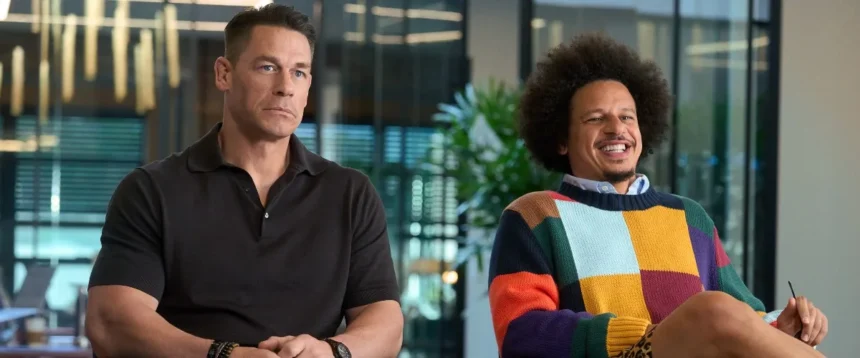
The latest John Cena star vehicle is one of his best—a profane, bawdy, slapstick-infused comedy with sentimental moments
The latest John Cena star vehicle is one of his best: Little Brother, a profane, bawdy, slapstick-infused comedy with a few sentimental moments that might make you misty-eyed even if you think you’re immune to such manipulations. Director Matt Spicer and co-screenwriters Jarrad Paul and Andrew Mogel know what kind of movie they’re making here, and not only embrace it, but elevate it.
Cena plays a semi-famous guy named Rudd Landy, who built a real estate empire despite his humble origins. He’s about to debut as a contestant on a cutthroat unscripted competitive “reality” show about real estate titled “NYC Hustlers.” Rudd’s wife, Deirdre (Michelle Monaghan), and their two teenage sons are emotional casualties of Rudd’s obsessive pursuit of fortune and fame.
There’s a personal component to Rudd’s obsession: He got rich to gain the respect of his older brother Josh (Chris Meloni), a far more famous real estate mogul who has made Rudd feel like garbage by outshining him in every area of life ever since they were kids.



The plot
Rudd’s unhappy but stable life is upended by Marcus Pinchel (Eric André), an orphan who was briefly mentored by Rudd in the Big Brothers and Sisters program three decades earlier. The first section of the movie cross-cuts between Rudd’s privileged existence and Marcus’s attempts to reunite with his onetime big bro while surviving day-to-day as an unhoused American.
Marcus wheedles his way into the Landys’ lives by presenting himself as Rudd’s brother, which, as Rudd points out, is really stretching the definition of that word. Deirdre is one of those trophy wives who seems as if she’s trying to atone for her privilege by throwing herself into situations where she can feel like a selfless rescuer.
What works
This is a cheerfully silly R-rated movie, expertly done. That’s the space where both Cena and André shine most brightly. Monaghan, Meloni, and other key players more than hold their own. There’s elaborately crafted smutty dialogue, scatological humor galore, and even an unexpectedly frank public sex act.
But this weird little movie is also about something—actually, several things. One is the psychic damage visited upon nice people by bullies. Another is progressive populism, connecting to filmmakers that believe empathy is the glue that binds the inhabitants of civilized countries.
What doesn’t
The movie doesn’t shy away from positioning the Big Brothers and Sisters programs as a metaphor for social services, but it doesn’t properly follow through on any of this. In fact, it tends to forget about the most promising avenues it opens. While subtexts are highlighted enough to be noticed, they aren’t developed carefully enough to really sink in.
The verdict
There are many good slapstick movies with humanistic views of life. Rudd and Marcus both fall under this heading, even though they exist on different ends of the economic spectrum. Both are little brothers seeking approval and affection from a big brother.
Little Brother is now streaming on Netflix.