The seven-episode limited series adds a crotchety ‘Curb Your Enthusiasm’ sensibility to historical moments with mixed results
Having run out of aspects of contemporary American culture to kvetch about, Larry David turns his sights to the past with mixed results in HBO’s Life, Larry and the Pursuit of Unhappiness.
The seven-episode limited comedy series is backward-looking for the Curb Your Enthusiasm creator — both because it finds him using his modern sensibility as a filter through which to process American history and because the sketch structure is a throwback to David’s brief but memorable stint as a writer on Saturday Night Live.
The format
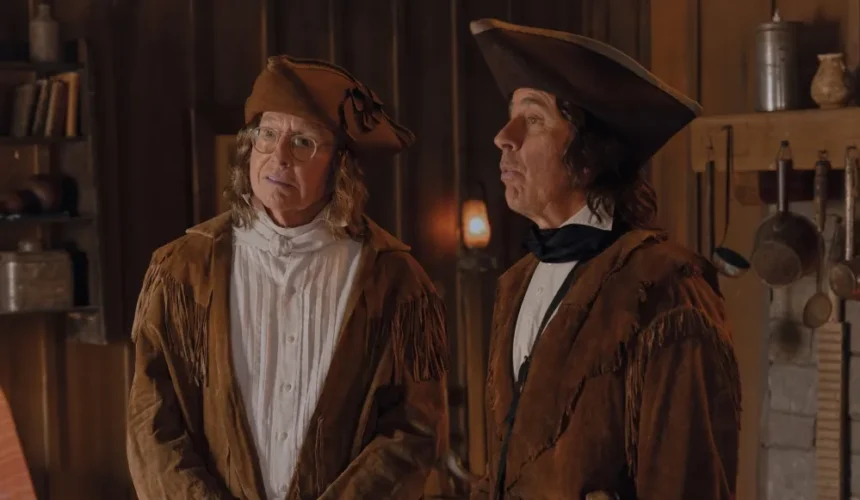
With the exception of one episode where an Abraham Lincoln-centric sketch takes up the majority of the half-hour, each installment includes four different vignettes in which a Larry David-esque protagonist is injected into a famous historical moment and produces cantankerous complications.



Of the full season of sketches, the review notes that maybe only five or six are actually good. Four or five are either “excruciatingly bad” or end without a conclusive sense of what the joke even was. The rest are exactly what they promise to be: Curb Your Enthusiasm circumstances and punchlines in mediocre period garb, briefly amusing and then going no deeper than the foundational gag.
The guest stars
Barack Obama, an executive producer along with Michelle Obama, introduces the first episode and gives the impression that he’s going to be the series’ version of Rod Serling. After those opening two minutes, he vanishes for much of the show before making a full-blown sketch appearance. The review notes that “no matter what you think of his politics, Obama’s comic timing is a precise and impressive thing.”
Among the guest stars, Bill Hader is singled out as the best, with Kathryn Hahn also praised. David gets an assortment of former collaborators including Jerry Seinfeld, JB Smoove, and Susie Essman.
The problem: formulaic and familiar
HBO is asking critics to be coy when it comes to specific sketches and guest star roles, which the review notes is “an unintentional acknowledgement of what is disappointing” about the series: too many sketches feature an identical core.
The first sketch finds David playing Robert Livingston, one of the original drafters of the Declaration of Independence. The joke is that Livingston has complaints far beyond the historically established grievances with King George III. It’s a laundry list sketch, and some are funny, most are not.
The series has the logline “Those who don’t know history…are doomed to watch Larry David repeat it,” and by “it,” the review assumes HBO means “Jokes he’s made on other shows.” Among the Curb Your Enthusiasm materials repurposed here are “Respect Wood,” “Chat ‘n’ Cut,” and at least one “Pretty, pretty good.”
The bottom line
The series is “formulaic and familiar, but not without high points.” Closing the series, Obama articulates what the show pretends is its theme: that “American progress has never been smooth or steady.” Neither is Life, Larry and the Pursuit of Unhappiness.