In the rubble of Gaza, a 21-minute film is making waves—not for its budget, but for its audacity. ‘Once Upon a Time in Gaza’ is the latest product of the burgeoning “Gazawood” movement, a raw and scathing satire that channels the spirit of Quentin Tarantino to craft a bloody revenge fantasy for Palestinian children.
The film opens with a title card that is pure provocation: “War is hell. But what if it made a cool movie?” It’s a question that frames the entire project, daring the audience to find catharsis in violence that, for the children of Gaza, is not a fantasy but a daily reality.
Gazawood’s Brutal Satire
The term “Gazawood” has emerged in recent months to describe a wave of short films emerging from the besieged enclave that use genre and dark humor to process the trauma of war. While some previous works have been literal appropriations of Western blockbusters, ‘Once Upon a Time in Gaza’ is an original creation that feels both brutally honest and cinematically ambitious.
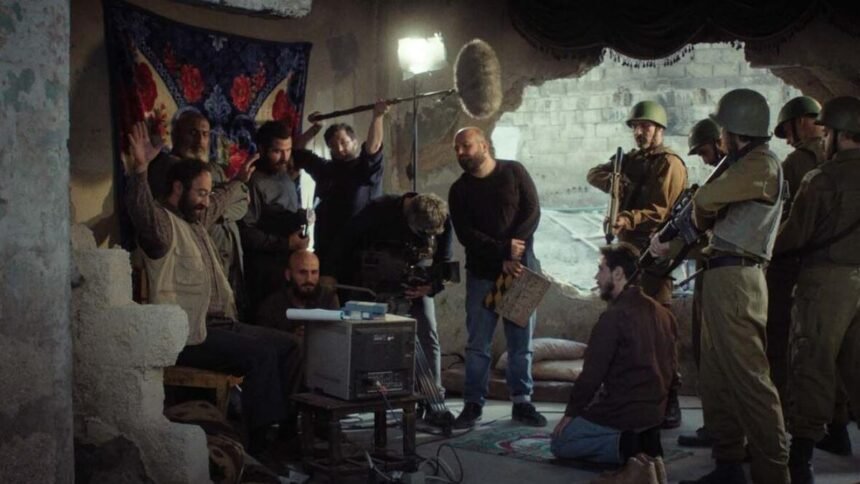
The plot is simple and savage. A group of children, dressed in the tattered costumes of their favorite superheroes, play a game of “kill the soldiers.” But their play becomes disturbingly real when they are confronted by a unit of actual soldiers. In a twist that defies the reality we know, the children fight back, dispatching the soldiers in stylized, Tarantino-esque violence.



The film’s aesthetic leans heavily into the director’s love for Spaghetti Westerns and grindhouse cinema. The desert landscapes of Gaza stand in for the American West, the dialogue is peppered with profane one-liners, and the action is punctuated by the kind of blood-squibs that would make Robert Rodriguez proud.
The Kids Are Alright (and Angry)
The film’s most potent weapon is its cast of child actors. It would be easy to dismiss the violence as exploitation, but the children perform with an intensity that feels shockingly authentic. Their rage is palpable, their desire for justice felt in every frame. They are not playing oppressed victims; they are playing avengers.
This is not a film that offers a way out of the conflict. It does not plead for peace or offer a political solution. Instead, it offers a moment of cathartic rage. By giving the children the power to fight back, the film imagines a world where the violence is finally reversed, where the oppressor is the one who meets a brutal end.
The Tarantino Connection
The influence of directors like Quentin Tarantino and Robert Rodriguez is obvious, but the film is not merely an imitation. It uses their grammar to tell a story that is uniquely Palestinian. The director, a young filmmaker who worked as a fixer for international journalists before picking up a camera, understands that for children in Gaza, the lines between play and survival, movie and memory, are already blurred.
‘Once Upon a Time in Gaza’ is not a subtle film. It is a cry of anger from a generation that has known nothing but war. It will offend, provoke, and unsettle. That is precisely its purpose.
In the end, the film refuses to be just a movie. It is a document of a people who, denied the right to life, have decided to imagine a world where they are the ones holding the gun. The title card at the end of the film reads: “Dedicated to the children who survived. And the ones who didn’t.” It is a sobering reminder that in Gaza, the screen is the only place where the good guys ever win.