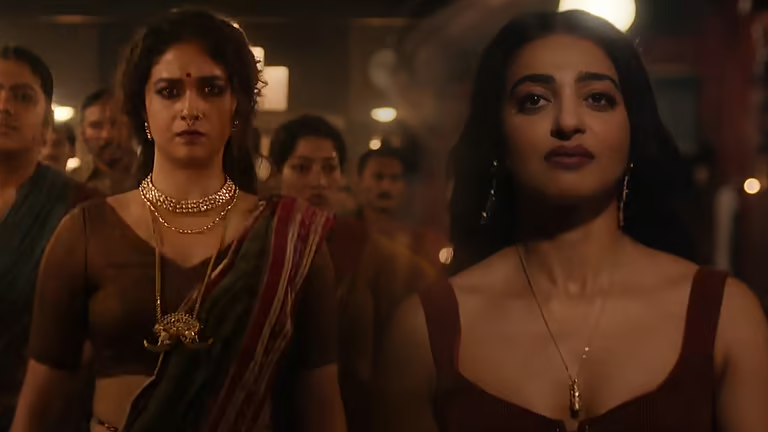
Mumbai: In this age of remakes, adaptations and loose inspirations, it’s hard not to nurse a soft spot for originality. The moment a period production arrives that isn’t based on pre-existing mythology, literature, movies or true events, it’s like discovering a rare animal or an uninhabited island at the corner of the earth. The heart rate shoots up. The mind hopes. You mean world-building is the actual building of a world without blueprints? The characters and rules are conceived from scratch? Backstories are created? How is that possible?
Akka is a five-episode drama that unfolds in a matriarchal kingdom in 1980s South India. The last time a Hindi series prompted such wonder at narrative ambition, it was Mandala Murders — from the same studio. The result, however, is similar: it’s doubly distressing when you realise such islands are uninhabitable, and undiscovered, for a reason. It probably looks exotic and mysterious from a plane, but it’s an optical illusion; the clouds were just being naughty that day.
All Themes, No Breathing Room
Akka is all themes and labels, and it doesn’t stop flaunting them. The painfully elaborate universe feels like a cover for fundamentally shaky storytelling.
The kingdom of Pernuru is a high-literacy, prosperous city once ruled by the three sisters (“Akkas”) of a king who vanished. Despite a government merger in the 1940s, it stays spiritually autonomous. The descendants of the queens now run Pernuru as three regions: Malemar (house of fields), Perplady (house of seas) and Herkada (house of mountains). They monopolise state tenders for country liquor and gold, and bump off all grubby male competitors.


The story focuses on Bhavani (Keerthy Suresh), the gangster heiress of Malemar, who follows the royal lineage to the letter: no marriage, no inheriting the revered position of “Akka” without a child, and no mainland interference. Nepotism rules. The role reversals are neat — the man she loves is introduced in her kitchen, and he refuses to have a child with her out of wedlock.
The peace of Pernuru is disrupted when a cold-blooded siren named Rudra (Radhika Apte), with troubled roots in the kingdom, arrives to smash the matriarchy and empower the bitter Ken dolls of the land. A bit of Barbie, a dash of Black Panther, a sprinkle of The Crown. Rudra, with the help of a wily outcast named Shankar Anna (Anshuman Pushkar), wreaks havoc as a hired agent of chaos and a vengeful ex-resident.
A Story About Women, Run by Men
The novelty on paper is real — it’s a war of gazes: the villainous vamp in slinky dresses versus the warrior queen with unshakable principles. The problem is that Akka, a story about women who run the show, is a show run entirely by men. And it shows.
Despite the design, the male gaze bleeds into the cracks; it cannot stop fetishising — and constantly reminding the viewer of — the sheer ingenuity of the concept. Not a minute goes by without hearing the word “aurat” in different tones; not a scene goes by without exposition dumps about gender subversion posing as verbal jibes.
The flashy dialogue is a main culprit, yanking viewers out of the world with hollow innuendos and one-liners: Is it nice to be a man in a woman’s world? This is the first time I’ve seen a man without manhood. Women like being on top, inside and outside the bedroom. Men prefer a “rndi” and not a “rani” in bed. Mother and sister slurs parade as crude wordplay (“beheno ke chakkar mein maa naa chd jaaye”). At one point, a disgruntled man compares cockfighting to sex before explaining the cringiest metaphor possible.
Conventional Beats Beneath the Design
It’s almost as if the screenplay itself cannot fathom the setting. To offset the creativity of the theme, it settles for the conventional beats of a period actioner. Rudra’s plan isn’t foolproof, but it makes Bhavani look like a fairly incompetent leader; key characters keep getting murdered without any spike in stakes or tension. The action sequences are unimaginatively staged, some resorting to gore just to keep the audience interested. The detailing is a hotchpotch of ethnic and religious elements. The background score belongs to a Survivor-style reality show. Two marginalised tribes play a key role, but their identity is weaponised into a loyal-versus-rebel divide.
The irony is lost on the makers: the good ones serve their mistresses and forgive old humiliations, while the bad ones dare to resent the royal family and fight for their own individualism. I like that Rudra preys on their rage, but the upper-caste-saviour syndrome is writ large. Even though the series tries to salvage this angle towards the end, the damage is done.
Subtext That Never Breathes
The broader idea is to reveal how a matriarchal society is not woke or revolutionary by default — that it’s prone to the same patterns and prejudices as its patriarchal counterparts. Unfortunately, the treatment reflects this simplistic female-replacing-male template.
Bhavani has blind spots; the experience of coming up against a monster of her ancestors’ making forces her to rethink the shackles of tradition. But none of the subtext is allowed to breathe; the fictional history is spoon-fed through flat delivery, predictable conflicts and face-offs.
It often feels like the gender dynamics are more gag than portrait. It doesn’t help that the leads are reduced to slow-mo walks and smirking punchlines. The show sees Keerthy Suresh’s Bhavani differently than we do; it’s a meaty role, but one held hostage to the spectacle of the premise. Suresh does what she can, but Akka fumbles the character.
Miscasting the Villain
Rudra being a campy baddie — a male-fantasy antagonist — with corny lines is not the issue. But Radhika Apte is fatally miscast. She’s such a naturalistic actor that she often looks like she’s spoofing the aura of a commercial villain rather than being one; she struggles to own the vibe. It’s a bit like watching Marion Cotillard awkwardly die in The Dark Knight Rises instead of Michael B. Jordan in Black Panther. She’s almost too qualified to pull off the role, so the mainstream excesses put Apte at odds with the tenor of the show.
A fitting cricket analogy: she’s a Test purist who is not equipped to handle the dumbed-down T20 game. It’s a pity, because this is a woman who incites emasculated men into “remembering” their worth in an environment rigged against them — an inverted version of the male politicos who weaponise feminism to get votes.
Shows like Akka are shaped by such performative optics. It starts with a cool hook — and then walks the plank like a safety-first entertainer drunk on its own posturing.