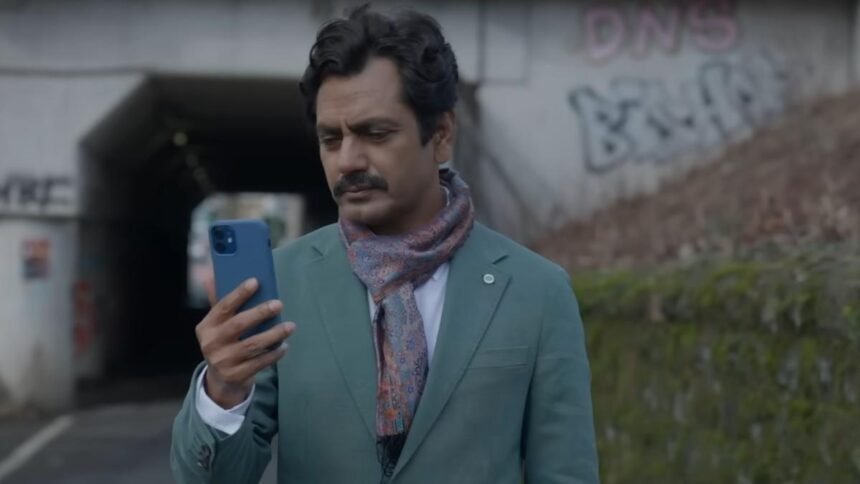
A man and a woman meet on a train in Europe. Losing themselves in conversation as they walk through picturesque, dreamy sites in Vienna, the two discover the delight of love. I was reminded of Richard Linklater’s wholesome talky romance Before Sunrise (1995) while watching Aditya Kripalani’s Main Actor Nahin Hoon, which largely follows two people walking in their respective cities as they connect over multiple video calls.
The similarities and charms end there. Main Actor Nahin Hoon wants to be more than looking at its characters as objects of love. They drive with a purpose, leading to some heavy-handed conversations that break the rhythm of the film’s minimalistic design — with the director’s voice often getting in the way of letting them stay human.
The disjoint is felt mildly in the opening portions, where the screenplay begins to detach from the characters.
Film Details
Main Actor Nahin Hoon is a Hindi indie romantic drama directed by Aditya Kripalani. The film stars Nawazuddin Siddiqui, Chitrangada Satarupa, and Naveen Kasturia in pivotal roles. With a runtime of two hours, the film is currently running in theatres. It draws clear inspiration from Richard Linklater’s 1995 classic Before Sunrise, but critics argue it falls significantly short of that standard.



The Story: A Banker and an Actor Connect Across Continents
Adnan, played by Nawazuddin Siddiqui, is a retired banker living in Frankfurt who has been living in melancholy of late. During a walk with his daughter, she asks him about his hobbies. He tells her he played smaller roles in his college plays. That’s when she suggests he go to an audition for an international production. The details are a bit too convenient, and so is Adnan’s quick decision to go for the audition. He is distant from the get-go.
In comparison, Kripalani introduces Mouni, played by Chitrangada Satarupa, as a frustrated, struggling actor in Mumbai. She is bitterly complaining about her life to her actor friends. Mouni is a trained actor who takes pride in quality work that satisfies her soul while balancing it with her saleswoman job. The two characters connect over multiple video calls, preparing for a combined audition.
The Problem with References: Pretentious or Artistic?
There is little to like about Mouni, and Kripalani caricatures her concerns. The one-dimensionality is apparent in how he imagines her living space, filled with film posters and a photo of the Globe Theatre in London — a dream place to perform for Mouni. Even the T-shirt Mouni wears carries a still of Madhabi Mukherjee from Satyajit Ray’s Mahanagar, where the lead character was a saleswoman too.
The references don’t really mean much apart from telling us about the filmmaker’s love for cinema and art, often coming across as a pretentious exercise. For example, Mouni suddenly goes on explaining her love for Tabu’s eyes in Chandi Bar (2001) or her admiration for Jeanne Moreau in Jim and Jules (1962). There is little authenticity in these moments, and even the camaraderie between Mouni and Adnan feels more constructed than lived-in. Kripalani doesn’t let the characters breathe their own air.
In the final act, another reference appears — Van Gogh’s 1890 painting ‘At Eternity’s Gate’ sits in the background as Adnan covers his face with his hands. The reviewer calls this an exhausting scene that overcomplicates the moment, making it seem more than what it actually is.
Performances: Incoherent and Confused
Even the performances are incoherent. Chitrangada Satarupa fuels the character with dramatic excess. There are multiple layers to the role that don’t quite come together to create an emotional backing.
Nawazuddin Siddiqui, on the other hand, appears confused as he tries to figure out his acting chops as Adnan, often struggling to get the rhythm right in his delivery. He still manages to keep the film afloat with his reactions, especially in some emotionally charged scenes in the final act.
Even here, however, Kripalani’s directorial choices interfere. The film, which began with a promise of simplicity, quickly turns into moments of insipid emptiness.
Comparison with Before Sunrise
The film invites comparison with Richard Linklater’s Before Sunrise (1995), a wholesome talky romance that follows two people walking and talking through Vienna. While Before Sunrise is celebrated for its natural, organic conversations and lived-in characters, Main Actor Nahin Hoon is criticized for being heavy-handed and forced. The director’s voice overpowers the characters, and what could have been charming becomes exhausting.
The Final Verdict
The reviewer sums up the film succinctly: “It says a lot, shows little, and means even less.”
What began with a promise of simplicity — two lonely souls connecting across continents, a retired banker rediscovering purpose, a struggling actor seeking validation — quickly turns into an exhausting exercise in pretension. The heavy-handed conversations break the rhythm. The references feel forced. The characters feel constructed, not lived-in.
For Nawazuddin Siddiqui fans, the final act offers glimpses of his talent through his reactions in emotionally charged scenes. But for most viewers, Main Actor Nahin Hoon may be a difficult sit.
Who Should Watch?
Nawazuddin Siddiqui fans might find value in his final act reactions, though they should lower their expectations. Art cinema lovers may appreciate the many cinematic references, but the review warns that these come across as pretentious rather than organic. Mainstream audiences are likely to find the film exhausting. And fans of Before Sunrise — the film it so clearly echoes — will likely be disappointed.