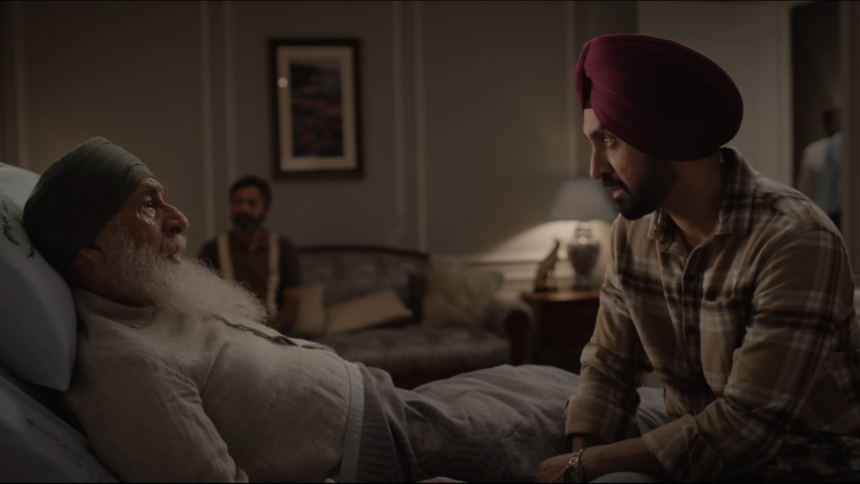
Imtiaz Ali’s best films have never been just love stories. They are philosophical inquiries dressed as romance, asking what it means to find yourself, to lose yourself, and to live with the choices you make. In ‘Main Vaapas Aaunga’, his most poignant work since Rockstar, he turns his gaze to perhaps the most devastating forced separation in modern South Asian history: the Partition of India.
Spanning two timelines, the film weaves together the tale of star-crossed lovers with the haunting reality of a broken subcontinent. The result is a film that is as heartbreaking as it is hopeful, leaving no eye dry and no heart untouched.
The Narrative: A Tale of Two Loves
Set against the backdrop of the 1947 Partition, the story follows a younger couple (Vedang Raina and Sharvari) who are torn apart by the tragedy that divided a nation. Simultaneously, in the present day, a cynical musician (Diljit Dosanjh) stumbles upon their unfinished love story while on a personal quest, forcing him to confront his own beliefs about love and loss.
The screenplay masterfully uses the ‘missing loved one’ trope—common in Imtiaz Ali’s work—but here, the stakes are not just emotional but geopolitical. The separation is not by choice but by the sword of history.



Performance: The Soul of the Film
Vedang Raina is a revelation. In his first major dramatic role, he carries the weight of a generation’s trauma on his young shoulders. His portrayal of a man losing his love not because their bond faltered but because an arbitrary line was drawn on a map is breathtaking.
Sharvari matches him beat for beat, delivering a performance that is fierce, vulnerable, and heartbreakingly real. Her expressions in the film’s climactic railway station sequence will haunt you long after the credits roll.
Diljit Dosanjh proves once again that he is one of the most underrated actors of his generation. As the jaded musician, his journey from cynical detachment to raw emotional catharsis is the film’s emotional anchor.
And then there is Naseeruddin Shah. In a role that spans decades, he does not act; he simply is. His monologue about returning to a home that no longer exists is a masterclass in minimalist acting.
Imtiaz Ali’s Mastery and A.R. Rahman’s Magic
Imtiaz Ali proves why he remains the poet of Indian cinema. He avoids melodrama, letting the tragedy of Partition simmer beneath the surface rather than boiling over. The violence is present but implied, the loss is felt deeply, and the love is eternal.
The music, composed by A.R. Rahman with lyrics by Irshad Kamil, is the film’s secret weapon. ‘Maskara’ has already become an anthem, but the real gems are the soulful ‘Ishq Mastana’ and the haunting melody ‘Phir Se’. Rahman’s background score, which blends folk instruments from both sides of the border, elevates every scene.
Why This Film Matters
In a time when the wounds of Partition are being reopened by political rhetoric, ‘Main Vaapas Aaunga’ offers a balm. It does not take sides. It simply mourns the human cost of division.
The film argues that while borders can separate land, they cannot sever the cord of shared culture, memory, and love. It is a plea for humanity, wrapped in the guise of a romantic tragedy.
The Verdict
‘Main Vaapas Aaunga’ is not merely a film; it is an experience. It will make you cry, it will make you reflect, and it will leave you with a lump in your throat.
Is it perfect? Perhaps not. The pacing drags slightly in the middle, and the modern-day track occasionally feels like it is intruding on a more powerful narrative. But these are minor quibbles.