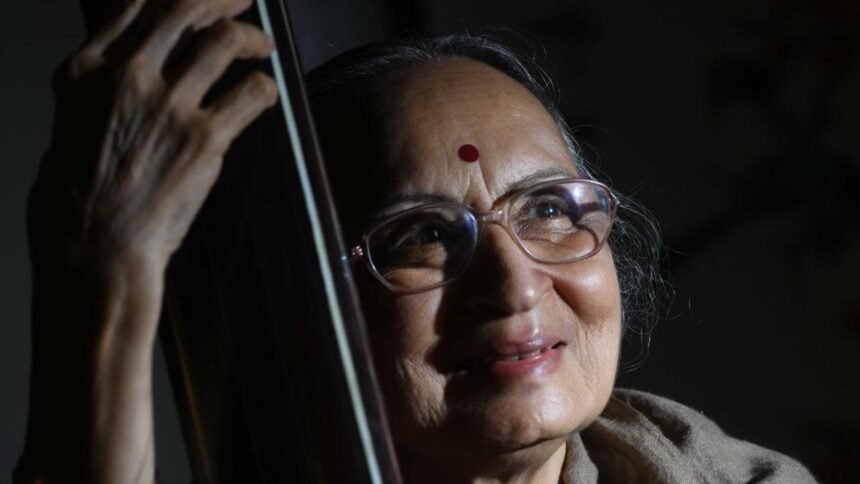
Lalith J. Rao, one of the foremost exponents of the Agra gharana and a torchbearer of its distinctive vocal tradition, passed away in Bengaluru on June 3, 2026, at the age of 83. For over six decades, she devoted herself not just to performing, but to preserving, teaching, and meticulously documenting one of Hindustani classical music’s most demanding styles.
Her death marks the end of a remarkable chapter in the history of the Agra-Atrauli gharana, leaving behind a rich legacy carried forward by a generation of disciples spread across the world.
Destiny Decided by a Three-Year-Old’s Ear
Born in 1942, Rao’s tryst with music began unusually early. At the age of three, her parents took her to a concert by the legendary Ustad Faiyaz Khan. Remarkably, the toddler sat through nearly three hours of rigorous classical music without a fuss. “My destiny was decided then,” she later recalled. “I was born for the Agra Gharana.”
Growing up in Bangalore, she began formal training under Pandit Rama Rao Naik, a direct disciple of Faiyaz Khan. Despite her prowess—winning the Sur Singar Sansad competition in Mumbai at just 14—her path was not linear. She holds a Master’s degree in Electrical Communication Engineering from the University of New Brunswick, Canada. However, after her marriage to Jayavanth Rao in 1967, her husband encouraged her to abandon engineering and return to music full-time.


Training Under the Masters
Relocating to Bombay (now Mumbai), Rao’s quest for knowledge led her to her ultimate guru: Ustad Khadim Hussain Khan, a towering figure of the Agra gharana known by the pen name ‘Sajan Piya’. Despite warnings that the Agra gharana’s “masculine” and demanding style might not suit a female vocalist, Rao was determined.
For 14 years, she immersed herself in his taalim (training). “He told me that nobody could take away what I had learned from my earlier gurus,” she recalled in a 2024 interview. “He said there may be small differences… but that I should learn from him with an open mind.” Her own approach to teaching later reflected this openness, emphasizing that students should develop their own artistic path while respecting tradition.
The Sound of the Agra Gharana
The Agra gharana is known for its robust, open-throated singing and intricate rhythmic play (layakari). It originated from the Dhrupad style of Haji Sujan Khan in Emperor Akbar’s court and evolved to include a vast repertoire of khayal, thumri, and tarana.
Rao became known for her ability to humanize this complex tradition. The Tribune noted she was “the first to modify certain phrases of male-centric Agra gharana to the general character of a woman’s larynx,” making the assertive gamak taan accessible to female vocalists. Yet, she never compromised on the core aesthetic. She often described the required vocal throw as having a “three-dimensional effect,” insisting that only emotions that touch the listener create the true “spark” in music.
The Archivist and the Guru
When a voice rupture hampered her performance career in 1994, Rao reinvented herself as one of the most important archivists of her tradition. Recognizing the fragility of oral traditions, she led projects for the Ford Foundation at the ITC Sangeet Research Academy (1989-1991) and recorded the gharana’s raags and compositions for the University of Washington’s Ethnomusicology Department.
She co-founded the trust Sajan Milap in 1978 to preserve the legacy of her Ustad and encouraged her students to record rare prakars (variants) of raags such as Bihag, Kanhada, and Nat to ensure their survival.
As a teacher, she was known to be generous and inspiring. A disciple recalled her words: “I will teach you, but I don’t take any gurudakshina. You should practise and sing well, that will be a tribute to my gurus.” Her notable disciples include Bharathi Pratap, Manohar Patwardhan, and Tara Kini, among many others. Through them, the “banyan tree” (Vat-Vriksha) of the Agra gharana continues to spread.