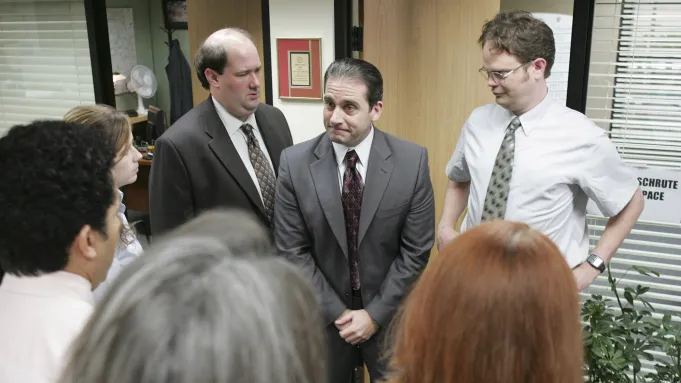
On March 24, 2005, NBC aired the first episode of The Office, an American remake of the universally acclaimed, Golden Globe-winning BBC comedy of the same name. The premiere, a mockumentary that introduced the staff of the Dunder Mifflin Paper Company’s branch in Scranton, Pennsylvania, pulled in a decent-sized audience that night. It drew 11.2 million viewers following an episode of The Apprentice — but even with that start, expectations for the show were not high.
NBC had produced a pilot for The Office, written by King of the Hill co-creator Greg Daniels, in early 2004, just after Ricky Gervais and Stephen Merchant’s BBC show won the Golden Globe for best comedy and Gervais took home the award for best actor in a comedy. The network ordered the show to series that spring but picked up only five more episodes. After premiering on a Thursday, the remaining episodes ran on Tuesday nights, where it struggled.
The Beginning
Greg Daniels, a veteran of Saturday Night Live and The Simpsons, co-created King of the Hill with Mike Judge, which became Fox’s second long-running primetime animated series. As he was nearing the end of a deal with Fox, Daniels began looking for new projects to develop free of any deal with a studio or network.
Greg Daniels: Ari Emanuel, who was my agent, sent me a VHS cassette called The Office and said, “Maybe you’d be interested in looking at this.” It was a sort of a boring title, and I didn’t really pay attention to it over the Christmas holidays. And then he called me the beginning of January. He said, “I’m going to send it to the next guy if you’re not interested.” And I was like, “Well, hang on, let me look at it.” At like 11 p.m. I popped it in the VCR, and I stayed up until 2 a.m. watching the first season. I just thought it was extraordinary and beautiful and hilarious.



Michael Schur: I was a huge fan of the British Office. I thought it was a terrible idea to adapt it, as did everyone.
B.J. Novak (to the Chicago Tribune in 2015): The Office was not a good bet. The British show was so edgy and bleak and quiet; there was no music. It was a really unglamorous environment, but it was very cool. The American version didn’t even have that advantage because it was [considered] so lame to do an American remake.
Daniels met with Gervais and Merchant, as well as producer Ben Silverman, who held the rights to any potential remake.
Daniels: We kind of hit it off. One of the reasons was that one of Ricky Gervais’ favorite Simpsons episodes was one that I had written called “Homer Badman,” so that turned out to be super lucky for me. I was talking about how I would adapt it and about the attention to realism and sincere emotion that was on King of the Hill, and I felt like when I talked to them about The Office, that’s some of the stuff I was talking about. I think Stephen and Ricky liked that approach, and they were like, “Well, OK, let’s do this. You can be the one that adapts it in the United States.”
The thought was that it was probably going to be at something like HBO, because I felt like the closest thing [to The Office] in tone was The Larry Sanders Show, and HBO had made that. Then we found out in the selling of it that the person who was most excited for it was Kevin Reilly, who was the president of FX, and FX was also very cool and experimental. I thought, “All right, maybe that’ll be a good place for it.” But then Kevin became the president of NBC, but he still wanted it. At this point, I was starting to feel like, “Oh boy, I don’t know if this is an NBC show.” They were very much in the multicamera business, and Will & Grace was the top show [after Friends and Frasier ended long runs in 2004]. It was a little bit stressful to think of an NBC version of the show. But Kevin was really into it.
Welcome to Dunder Mifflin
NBC ordered a pilot, with Universal TV and Silverman’s Reveille producing. Daniels initially pitched an original script to start the series, where viewers would meet the characters via a company awards show — an idea that eventually came back around as “The Dundies,” which led off the second season. Then he reconsidered.
Daniels: I started to become worried that the NBC development machines would note it too much if it was a completely new script, and that it would be much harder to maintain this unique tone. So I said I’m going to do a little Americanization of the British pilot. We avoided all the notes process on the pilot, because it was just a small rewrite. Now, I ended up rewriting it more significantly, and you can see a lot of the stuff that I put in the long, superfan version of the pilot that’s on Peacock. But when it came down to cutting it down to air time, it did resemble the British pilot pretty closely.
Daniels very early on thought Daily Show regular Steve Carell would be right for the lead role of Dunder Mifflin branch manager Michael Scott, but there was a problem.
Daniels: The casting process was enormous. We started off thinking of Steve Carell, because the NBC movie executives had given Ben a copy of Bruce Almighty, where Steve had an incredible cameo as a newscaster who was taken over by outside forces and didn’t really understand what was happening to him. We saw that, and we were like, “Oh, this guy is fabulous.” I really wanted to crew up with Allison Jones, the casting director who had done Freaks and Geeks, and I thought she was the best casting director. While her deal was being made, we had said to Steve’s people, “Hang on, we really want to do it.” But they took another job that came [on another NBC sitcom, Come to Papa]. That was very frustrating. Then we began this months-long search for who else could play the character.
After seriously considering Bob Odenkirk for the role of Michael, The Office team got word that it would be OK to cast Carell as Michael, in second position to Come to Papa. The pilot was filmed in February 2004, with Rainn Wilson, John Krasinski, Jenna Fischer and Novak starring alongside Carell. Ken Kwapis, who had helmed a number of episodes of The Larry Sanders Show and Malcolm in the Middle — one of the very few successful single-camera network comedies of the early 2000s — directed.
The Hiring Phase
NBC picked up The Office to series at the 2004 upfronts, making it a midseason show. Come to Papa wouldn’t air until that summer and was quickly canceled, freeing Carell from that commitment, while Daniels set about hiring writers and other crewmembers. One of the writers — Novak — was already in the fold, having played temp worker Ryan Howard in the pilot.
Daniels: B.J. was the first person I hired. It’s a little bit superstitious for me, because Johnny Hardwick, who played Dale and was a writer on King of the Hill, was the first person I hired on that show. I hired Johnny Hardwick because he was a stand-up and he had a fantastic joke about his father yelling at him to close the front door, and I was like, “Oh, that’s kind of a great [line] for Hank.” Also, I love Monty Python [where the troupe wrote and performed every sketch], and Ricky was the creator of The Office and also the star. It just felt to me like this is a really good place for writer-performers. I wanted to have a writer-performer vibe in the show.
Daniels read more than 100 script submissions but didn’t necessarily go with experienced sitcom writers in filling the writers room. Lieberstein had the most experience, having worked on series including The Drew Carey Show and The Bernie Mac Show, as well as with Daniels on King of the Hill (the two also have a personal connection; they’re brothers-in-law). Schur was coming off several years as an SNL writer, and Kaling hadn’t been in a writers room before. Novak had written for Bob Saget’s short-lived WB sitcom Raising Dad but was better known for MTV’s Punk’d and was doing stand-up comedy.
Mindy Kaling: I was hired as a writer. Greg Daniels had seen my off-off-Broadway play Matt and Ben, which had transferred from New York to L.A. for a very short engagement after we won the Fringe Festival. He’d seen it there and hired me as a writer because of that, and I had an Arrested Development spec.
Paul Lieberstein: It was a really easy sell, because I was a big fan of the British show. I don’t remember exactly, but I do remember telling him I was interested, or asking if he was, and he was like, “Of course, I think the show is made for you,” or something like that. We must have asked each other. A lot of times we used to go through our manager when it came to business. I remember it being very simple and that we were both very on board.
Schur: I was at SNL, and my then-girlfriend, now-wife, was out in L.A., and I realized I had to move out here. I started prepping really early to make the move. I wrote a Curb Your Enthusiasm spec script, which is a funny exercise for a show that’s mostly improvised, but I worked really hard on it.
I went and met Greg, and my interview with Greg was like two hours long. We went deeply in depth about the British show and about adaptations of shows. In the middle of the interview, which was at his offices for King the Hill, he said, “My back is kind of hurting me. Do you mind if I lie down?” He lay on the floor in front of me. To a person who was looking at the meeting through the [office window], it would have vaguely looked like I was Greg’s therapist sitting in a chair, and he was lying prone and sort of pontificating to the ceiling. It was a weird meeting, but I loved every second of it. I left, and I had a BlackBerry, and I sent my agent and manager a BlackBerry message that said, “I still don’t think it’s a good idea to adapt The Office, and I don’t think it’s going to work, but if that guy offers me a job, I’m going to take it, because I’m pretty sure he could teach me how to write.” They still send me that email every couple of years.
The Remake Problem
The news that NBC was remaking The Office was initially met with skepticism, both from fans of the BBC series and a general sense that remakes lost something in translation. NBC also had a specific remake disaster in its recent past: Coupling, a remake of a well-regarded British sitcom that the network had positioned as a potential Friends successor (and had Silverman among its executive producers). It premiered in fall 2003 and flopped badly; NBC canceled it after just four episodes had aired.
Season One
The cast and crew had five episodes after the pilot to fill out their first season, a small order even for a midseason show at the time. The writers got to work breaking stories and writing drafts of scripts — and then doing lots of rewrites.
Lieberstein: All of season one was written and rewritten and rewritten and rewritten in the room. The room was a big part of all of it. Season one of any show I’ve been on, you have to rewrite to death, because you’re really discovering it as you go. I remember doing the script [for “Health Care,” the third episode and Lieberstein’s first credit on the show] several times, and I think what we kept doing was taking out story and taking out story. We were just finding these big scenes that allowed everyone to be funny and have a point of view and really tried to sit in a very simple idea.
Schur: If memory serves, Greg, if he had wanted to, could have taken full writing credit for every one of those six episodes, and probably most of them from season two as well, because we wrote and rewrote and rewrote and re-broke and re-broke [stories] over and over and over again. But with “The Alliance” [episode four, Schur’s first Office writing credit] I would say, of the first draft I turned in, maybe 14 percent of what I wrote probably made it in the [final] script. But that was just the process. What Greg told us early on was that we break these stories together. One person goes off and writes them and does their best job and puts their own voice into it, and then the script returns to the collective of the writers room, and the writers room does the work of rewriting it. So it was to be expected. It was like, yes, this is the process of how comedy shows are made.
Turning the Corner
Despite the modest ratings, NBC ordered a second season of The Office and was rewarded with substantially improved viewer numbers, a new revenue stream and a creative flowering that resulted from some subtle but important changes in the way the writers approached the show.
Daniels: The learning process for me over the course of the first two years was to not be as reverent of the original. The main thing was that Michael Scott was pretty heavily criticized by the show. He was not a good person in the first season.
[After season one] I was like, “OK, we were very faithful to the British show, and we are barely surviving.” I decided to be less faithful to the British show and to incorporate more of what I had learned on King of the Hill. In the very first iteration of that show, Hank Hill was a little bit more of an unlikable character, and I made various changes to articulate to myself what was unlikable about him and then fix it so that by the time the pilot aired, he was in good shape.
So I said [to NBC], “I think I know how to change Michael Scott,” and I made a list of maybe eight things that I would do to change Michael in the minds of the audience, and each one of them became the ending of an episode. For instance, in “The Dundies” I was proving the point that the staff can complain about him, but when someone outside the staff picks on him, they defend him. It was basically nudging him from a person who is not part of your group, and you don’t really like them, to a person who you’re frustrated with often, but is part of your group — he’s more of the frustrating uncle or something. There were other things. We had an episode where he actually turned out to be very good at sales, and that his incompetence was more a Peter Principle thing of being promoted past what he was good at to being the manager.
The ‘Office’ Legacy
Season two would win the Emmy for best comedy series, and The Office went on to a hugely successful run, ending in May 2013 after nine seasons and 202 episodes. Season one’s writers would go on to create and run a host of series. Kaling is responsible for The Mindy Project (in which she also starred), Never Have I Ever and Running Point, among others. Schur and Daniels co-created Parks and Recreation, and Schur then went on to create The Good Place and A Man on the Inside and co-create Brooklyn Nine-Nine, among others.
Lieberstein succeeded Daniels as showrunner of The Office and later was an exec producer of HBO’s The Newsroom, ran AMC’s Lucky Hank and wrote, directed and starred in the feature film Song of Back and Neck. Novak wrote, directed and starred in the 2022 film Vengeance, created FX’s The Premise and has written two best-selling books. In addition to Parks and Rec, Daniels created Upload and Space Force (the latter with Carell) and is working on both a King of the Hill revival and a new mockumentary set in the same world as The Office and chronicling a struggling newspaper.
The show also found another life in syndication and streaming: It was the most streamed show in the United States in 2020, its final year on Netflix, and has been one of Peacock’s best-performing shows since moving there in 2021.