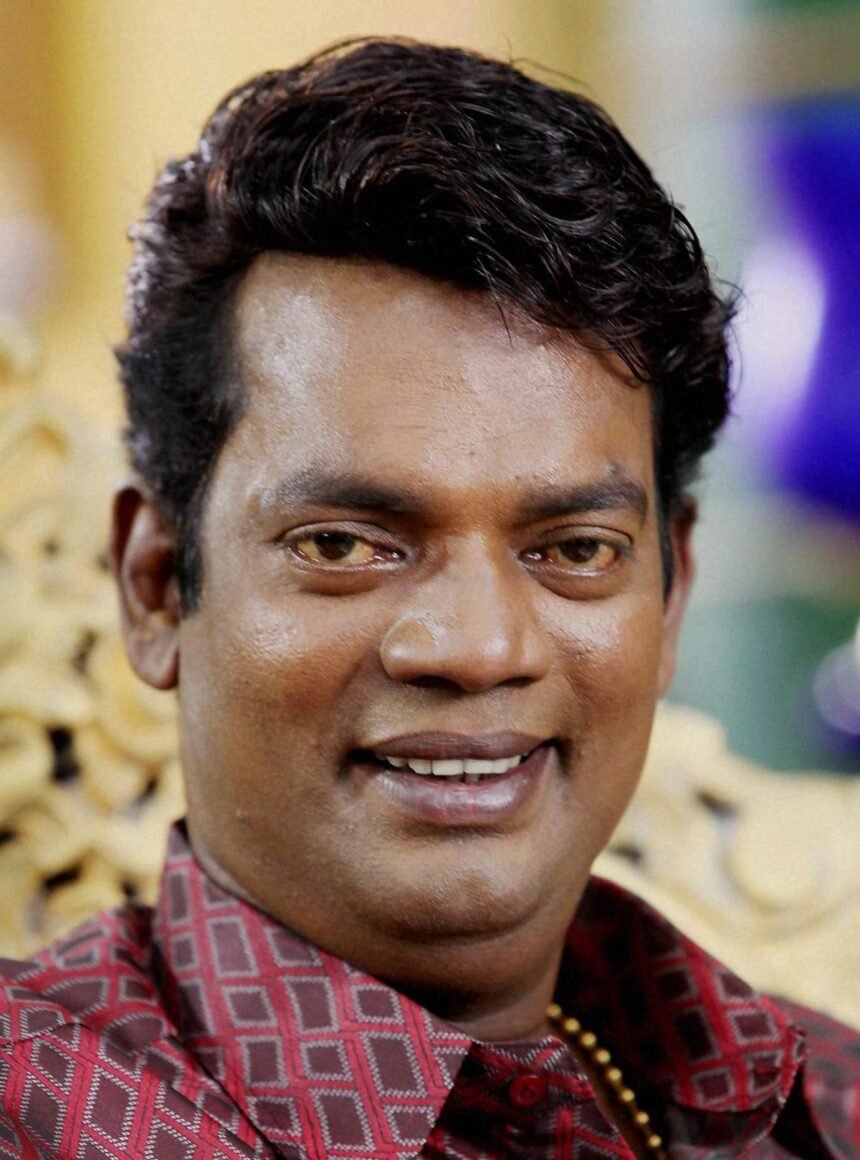
Long before he moved audiences to tears with his National Award-winning performance in ‘Adaminte Makan Abu’, Salim Kumar was the undisputed king of the stage, ruling the world of mimicry with a charisma and wit that made him a legend in his own right.
His was a journey that began not on a film set, but on the dusty college stages of Ernakulam. It was here, as a student at Maharaja’s College, that the foundations of his cinematic career were laid .
The College Prodigy
Salim Kumar’s tryst with mimicry was not a mere hobby; it was a passion so fierce that it shaped his academic life. He was a serial winner in mimicry contests at the university level long before he enthralled film audiences .
In a remarkable story that speaks to his determination, he secured admission to the BA programme at Maharaja’s College by literally promising the then principal that he would win prizes for the college . True to his word, he dominated the MG University Youth Festival, winning the first prize for three consecutive years .


His excellence, however, came at the expense of his academics. The university eventually barred him from appearing for his final exams due to inadequate attendance. By then, he was already a professional mimicry artist with a foot in the film industry. The college, grateful for the laurels he had brought, allowed him to continue as a student for two more years to garner sufficient attendance. Thus, Salim Kumar has the distinction of spending five years at the college to complete his graduation .
The Kalabhavan Glory Days
From the college stage, Salim Kumar’s talents naturally flowed into the famed mimicry troupes of Kerala. He joined the iconic Cochin Kalabhavan in 1993, becoming a contemporary of the late Kalabhavan Mani . According to Kalabhavan Jayan, those two years were arguably the best period of Kalabhavan, fueled by a healthy competition between the two titans to outsmart each other, elevating the overall performance .
While on stage, he was renowned for his spot-on imitation of actor Jagadeesh. More than mere imitation, however, his strength lay in his acting ability, supported by humorous gestures and his famously expressive wide eyes .
He later moved to Cochin Sagar, a troupe started by the late mimicry artiste and actor Aby, continuing to refine his craft .
The ‘Dhe Maveli Kombathu’ Revolution
Salim Kumar’s fame transcended stage shows and entered the living rooms of Malayalis through the audio cassette revolution. He became a household name through the blockbuster ‘Dhe Maveli Kombathu’ series, which became a cult phenomenon in the 1990s .
These audio tapes, filled with irreverent humor and sharp political satire, were a staple in Kerala homes and vehicles. His ability to mimic political leaders like K.R. Gauri and K. Karunakaran made him a pioneer in political mimicry .
His popularity further soared through television comedy shows like ‘Comicola’ and ‘Cinemala’, cementing his status as a mass entertainer and paving the way for his eventual entry into films .
Film Debut and the Big Break
Even as he conquered other mediums, his heart remained in films. Interestingly, Salim Kumar entered the film industry the very morning after his wedding. On September 14, 1996, a car arrived at his relative’s house and took him to his first film shoot, ‘Ishtamanu Nooru Vattam’ .
While he played roles in the late 90s, it was the 2000 blockbuster ‘Thenkashipattanam’ that proved to be his turning point, establishing him as a sought-after comedian capable of holding his own alongside stars . He went on to act in over 300 films, but the comedic timing and crowd connect he mastered on the mimicry stage remained his greatest weapon.
His mimicry roots never truly left him; they gave him the training, the timing, and the tenacity to evolve from a college champion into a National Award-winning thespian. As veteran mimicry artist K.S. Prasad noted, he was probably the first to imitate political leaders, a skill that made his comedy feel sharp, relevant, and ahead of its time .