Tokyo: Few people outside Indonesia are likely to be familiar with the war of independence that began there just as World War II was ending, resulting in hundreds of thousands of deaths at the hands of both Dutch soldiers and warring sectarian factions. The country finally achieved full emancipation from the Netherlands in 1949, though the wounds opened by the long and often brutal conflict would remain for decades.
Prolific Indonesian director Garin Nugroho revisits that pivotal period in Red Before Dawn (Merah Sebelum Fajar), a wartime road movie that condenses multiple aspects of the revolution into one rocky journey through hostile territory.
The Premise
Following a cast of diverse characters who travel from Jakarta to Yogyakarta in 1946, facing countless obstacles but growing closer along the way, the film attempts to show how people from various ethnic and religious backgrounds finally united behind a single flag.
On paper the idea is intriguing, and the film benefits from both an ambitious set-up and a highly cinematic setting — lush jungles and fields, rivers, villages and ancient ruins as the group makes its way across the countryside in the year following Indonesia’s declaration of independence.



Where It Falters
The film stumbles in its rather didactic brand of storytelling, with actors reciting reams of expository dialogue and situations that feel more demonstrative than dramatic.
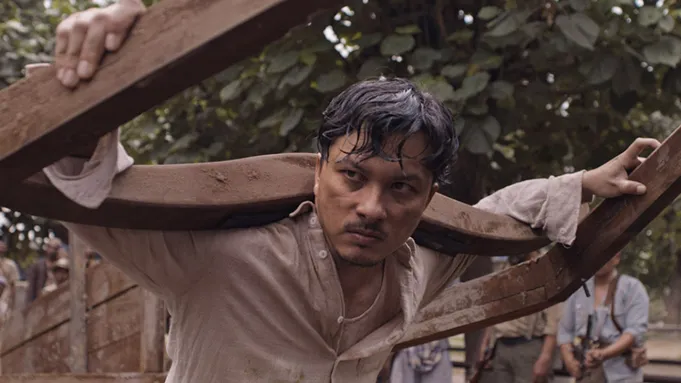
The pedagogical nature is evident from the opening scene, which uses a theatre piece to depict how the Dutch army showed zero mercy toward Indonesian freedom fighters, labelling them terrorists and executing them at will. Animated sequences are also used to depict the inner thoughts of the film’s hero and narrator, Frans (Nicholas Saputra), a “half-blood” whose mixed Dutch and Indonesian heritage makes him a living example of the colonial battle that tore his country apart.
The Journey
A respected engineer carrying a briefcase of valuable geological surveys, Frans sets out to deliver his plans to the newly formed independent government in Yogyakarta, while other parts of Indonesia remain under Dutch control.
He enlists an Indian driver, Qasim (Bront Palarae), to steer their truck across deadly lands, bringing along a blind radio operator, Arya (Nagra Pakusadewo), who hopes to spread the revolutionary gospel over the airwaves. Along the way they pick up a Chinese nurse, Fifi (Laura Basuki), and a lounge singer, Bandriah (Tissa Biani) — an eclectic ensemble hailing from all walks of Indonesian life.
The 600-mile journey brings them face-to-face with violent countrymen — devout Muslims standing their ground, Chinese landowners facing persecution, gun-toting rebels who see Frans and his crew as enemies rather than fellow combatants.
The Tension Problem
People get shot, stabbed, taken prisoner and kicked around, yet the tension is never high enough in a film that should be more thrilling. Music sequences, including a few songs performed by Biani, add lightness, as does a romantic subplot between Frans and Fifi that winds up feeling superfluous.
Nugroho — a writer-director-producer with nearly 40 movies across four decades — displays solid craft throughout, especially in village settings that mix rural life with wartime devastation. But his narrative is ultimately more illustrative than organic, as if he needed to cover as many facets of the conflict as possible within two hours, explaining the stakes over and over and deflating much of the suspense.
The Verdict
Still, the traumas Frans and the others face leave their mark by the end, accumulating into a vision of the Indonesian revolution that underscores how violent the era truly was — yet how it was also filled with passion and hope.
True to its title, the film depicts the years before the dawn of a new nation as red ones indeed, marked by plenty of bloodshed but also a burning desire for freedom.