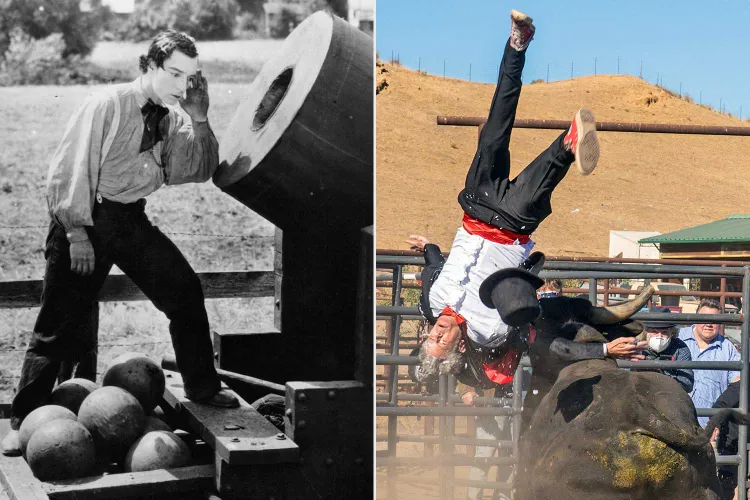
Before Johnny Knoxville and modern stunt performers, there was Buster Keaton—the silent film icon who risked his life for a laugh and never cracked a smile
Before Johnny Knoxville made us laugh with some of the most insane stunts in history, there was Buster Keaton. Born Joseph Frank Keaton, the actor was a star of vaudeville and early film, known for his prowess at physical comedy and stunt work. He began acting at just 3 years old and continued in vaudeville until he met Fatty Arbuckle in February 1917.
Arbuckle got Keaton started in film and from there, his success began to grow. Keaton worked as Arbuckle’s protégé over the following years, rising to the role of assistant director and writer.
How Buster got his name
In a 1963 interview, Keaton revealed that he got the nickname Buster from magician Harry Houdini, with whom his parents were performing when he was a young child.
“I fell down a flight of stairs when I was around six months old. They picked me up … no bruises, didn’t seem to hurt myself, and Houdini said, ‘That was a Buster!’ And the old man says, ‘That’s a good name; we’ll call him that.'”



The stunts that made him legendary
In the early 1920s, Keaton got to work on his own films, eventually moving into feature-length productions. It was there that he experimented with physical comedy like no one before him had. Keaton was unafraid of doing his own stunts. He’s best known for a death-defying stunt in 1928’s Steamboat Bill, Jr., where a 4,000-pound facade of a house had to fall just so in order for the actor to walk away unscathed.
While he made it through that stunt unharmed, there were instances of injury. Notably, in 1924’s Sherlock Jr., Keaton broke his neck without immediately realizing it. It would be years of pain that he hadn’t equated with the on-set injury that led him to get an X-ray, which showed the break.
The Great Stone Face
Keaton was also known for remaining straight-faced through any situation he went through on screen, gaining the nickname “The Great Stone Face.” His deadpan expression became his trademark, making his physical comedy even more remarkable—no matter how dangerous or absurd the stunt, his face never betrayed a hint of emotion.
Later years and legacy
Keaton enjoyed success until the late 1920s, when personal and professional strife led him away from the spotlight. He still had the love of performing in his heart and did eventually return to acting in the 1940s, revered by those who followed him for his unforgettable moments on screen. He enjoyed roles throughout the 1950s and 1960s.
In 1966, Keaton died of lung cancer at age 70.
Today, his influence can be seen in the work of Johnny Knoxville, Jackie Chan, and countless other physical comedians who push the boundaries of what the human body can endure for entertainment. Keaton proved that the greatest comedy comes from real risk—and that sometimes, the funniest thing you can do is keep a straight face.