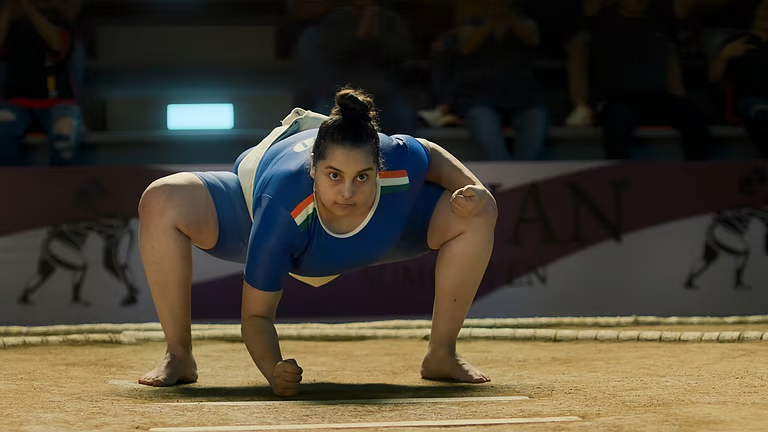
Mumbai: No matter how safe and formulaic many biopics choose to be, sometimes it’s the subject alone that does the heavy-lifting. This is quite literal in Sumo Didi, a Hindi film inspired by the life of Hetal Dave, India’s first female professional sumo wrestler.
The underdog checklist already exists: an unmarried girl mocked for her weight; a middle-class background; a notoriously patriarchal society; a supportive father; an apathetic federation; a passion as rare and mismatched as the Jamaican bobsleigh team in Cool Runnings; and a sport that weaponises the body-shaming stigmas that infect most cultures. When life itself offers a winning theme, all fiction has to do is show up.
The Problem With Showing Up Too Hard
Like several Hindi biographical dramas, Sumo Didi threatens to show up too hard. It insists on looking and feeling like a movie, in the hope that audiences won’t feel alienated by a sport they’re wired to scoff at.
For instance, her Mumbai-based struggle becomes a Kolkata-based rise — partly because of her Marwari roots, but largely because the city is more cinematic. The father being her first coach (which is maybe too Dangal-coded) is swapped for a best friend and romantic interest. This man, Akshat (a sincere Chaitanya Sharma), is over-designed, almost like the film wants to offset the unorthodox core with conventional figures: an all-in-one physio-coach who believes in her and delivers corny speeches when she’s down.


The creative liberty likely extends to her career arc: the “adapted” results of tournaments, a what-will-people-say mother (Anubha Fatehpura), and the dogged pursuit of a legendary Japanese champion for professional coaching. The obstacle of Hetal’s diet — vegetarianism — is barely addressed.
What It Gets Right
But there is merit in how Sumo Didi resists broader strokes. It doesn’t go overboard staging Hetal as an outcast demonised by society. The men around her understand her better than the women do.
There’s something about watching the late Nitesh Pandey as the gentle, progressive father — a bit like the late Farooq Sheikh in Yeh Jawaani Hai Deewani. He brings empathy to a domestic situation that could have easily dialled up the volume; it’s hard not to feel the loss of the actor.
The social details help: Hetal being made to sit next to her cousin during a rishta meeting so the cousin looks slimmer; her aunt finding inspiration in her while going through a divorce (a Dum Laga Ke Haisha touch); her brother applying for sponsorship under the pretext of watching porn.
The training montage in Kolkata — balancing exercises on gas cylinders, buses and footballs — is nicely composed, as is a corresponding montage in Japan. The contrast between them is neat, suggesting that all the grassroots training in the world is only enough to reach a certain level.
No Shortcuts
The 118-minute film often unfolds in a hurry, especially when hastening Hetal’s transition from Judo champion to her first steps in sumo. But it’s not all victory and glory the moment she takes the ring; she has to taste enough defeat and disappointment to earn her shot at the top.
Crucially, the story remains about the individual without succumbing to patriotic fervour. Because athletes like Hetal succeed despite the system, not because of it; they compete despite the nation, not because of it. The sport is a lonely one, particularly in South Asian countries that dismiss female strength as a cultural disability. It’s also an anticlimactic sport — more accumulative than visual, short and abrupt and technical — but the film conveys the years of conditioning it takes to win or lose in a minute. Even if the dialogue is on the nose, the writing gets the internalised feminism of the full-contact contest.
The Performance
The swiftness of the film is tamed by Shriyam Bhagnani’s lived-in and durable performance. She finds the sweet spot between mainstream expression and physical rigour. It’s a challenging role, but you can see the transformation across time-lapse montages and phases; the toll stays visible on her face, her gait, and in her exhausted gaze.
It’s tempting to view effort and body alterations as the “evidence” of good acting. But Bhagnani commits to the psychology: a silent courage that conveys how the split-second sport is merely the culmination of a lifelong battle.
The Verdict
That someone like Hetal Dave reaches the mat is, in itself, a minor miracle. Sumo Didi just about lets this context breathe. The story stops short of weighing down — and branding — the remarkable person it centres. You can’t say that about most Indian biopics these days. The bar may be low, but perhaps such films are better defined by the pitfalls they avoid.