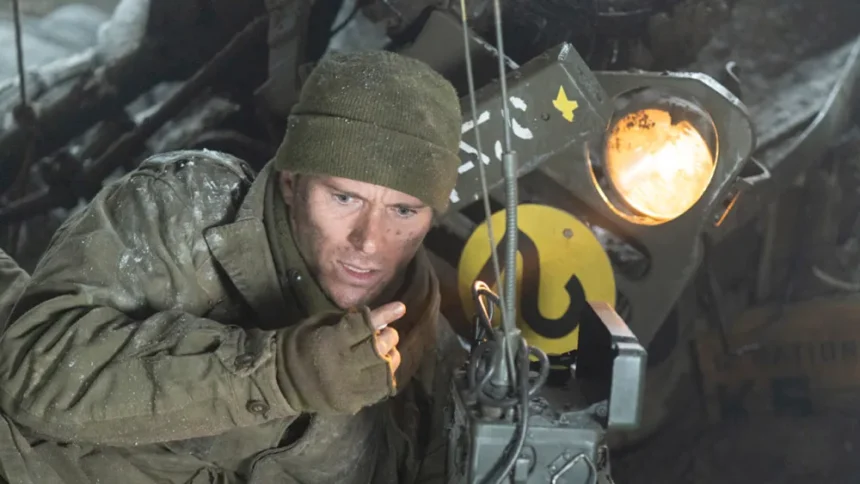
The second time is not the charm for director Rod Lurie, producer Marc Frydman and actor Scott Eastwood, reuniting for their second war film after 2020’s excellent The Outpost. Set during the Battle of the Bulge in World War II, Lucky Strike features the same immersive visual qualities as its predecessor, as well as an admirable commitment to authenticity. But this effort about a soldier desperately trying to survive behind enemy lines never overcomes its oppressive air of familiarity, suffering in comparison to too many war films in recent years (Saving Private Ryan, Inglourious Basterds, *1917*, etc.) to which it bears obvious resemblances.
Episodic storyline with familiar beats
After a powerful but incongruous opening, shot in black and white, in which we see a platoon of Black soldiers ambushed and massacred by the Germans, the story concentrates on Captain Castle (Eastwood), who finds himself having to travel 30 kilometers on his own through wintry terrain when his unit of white soldiers is completely wiped out. Suffering a leg injury and toting a portable radio nicknamed “Lassie” that facilitates lifesaving communication with the American forces, he undergoes a series of harrowing confrontations with the Nazis.
The episodic storyline features several effectively suspenseful sequences, including one in which Castle is forced to play dead for an excruciatingly long time with German soldiers only a few feet away. Another involves his being given refuge by a French-speaking family who are subsequently interrogated by menacing German soldiers while he hides in the basement. And in the film’s most arresting scene, he encounters a fellow American soldier (Taylor John Smith), who engages him in friendly conversation that takes a darker turn and provides the meaning behind the film’s punning title.
Less than the sum of its parts
But Lucky Strike ultimately emerges as less than the sum of its more powerful parts, failing to sustain tension and suffering from forced would-be poetical moments such as Castle encountering a beautiful white horse standing alone in a wintry landscape. The dialogue is frequently ham-fisted, especially in an unnecessary framing device involving Castle’s post-war encounter with the woman (Aunjanue Ellis-Taylor, excellent) who invented the radio that saved his life. At one point he comments that the true meaning of the battle may or may not be understood 80 years later. A little on the nose.



Performance concerns
Eastwood bears an amazing physical and vocal resemblance to his famous father, but there’s an “it” factor lacking that prevents him from being compelling or charismatic enough to anchor the film for which he’s onscreen solo much of the running time. When he shares one scene with Colin Hanks as a tough-talking colonel, you inevitably find yourself taken out of the story and instead ruminating about nepo babies.
Technical merits
The film looks impressive despite its obvious budget limitations, with Lurie using a desaturated color palette and plenty of long, single-shot takes that provide a powerfully immersive experience. But for all its technical impressiveness, Lucky Strike never gathers the narrative momentum and suspense to which it aspires.