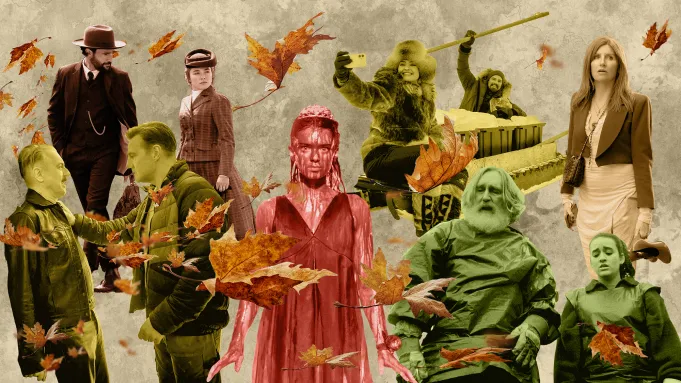
Television this fall has been awash in misery — dead wives, school shootings, hate crimes — and the best series found a way through it rather than drowning in it.
In a wide-ranging conversation for The Hollywood Reporter, critics Angie Han and Daniel Fienberg debated how shows use trauma, and which fall series rose above the pile-up of grief.
The problem with cheap trauma
Han noted that trauma has become a default shortcut to seriousness. Apple’s Nocturne gives Liev Schreiber’s ex-cop a dead wife, a dead kid and a dead partner. Peacock’s The Good Daughter opens with a murder and a school shooting, then keeps piling on. Not even robots escape: Disney+’s VisionQuest plays like a long series of therapy sessions.



“The misery starts to feel less affecting and more … cheap,” Han said.
Trauma done right
Both critics pointed to Starz’s British import Tip Toe, built around a horrific anti-gay hate crime, as proof that dark material can work. Creator Russell T Davies loves his characters enough to make them more than the sum of what happens to them, making the series less dreary than expected — and more gutting. Alan Cumming and David Morrissey deliver some of the year’s best performances.
Netflix’s East of Eden drew praise for letting Zoe Kazan restore the biblical sprawl her grandfather Elia trimmed from his 1955 film, while giving Florence Pugh and Hoon Lee standout showcases. Apple’s Small Prophets, from Mackenzie Crook, was singled out as a model for using trauma as an instigating event without wallowing, with Pearce Quigley giving a revelatory lead performance.
“The difference is between a story that grapples with tragedy to expand our understanding and one that thinks a character’s sadness makes them inherently interesting,” Han said.
The antidotes
For viewers worn down by gloom, the critics recommended Netflix’s Inuit comedy North of North, whose second season finds purpose in community and culture, led by Anna Lambe. They also praised Paramount+’s It Gets Worse for capturing the thrill and mortification of approaching adulthood, and HBO’s Youth, where Sharon Horgan finds humor and honesty in growing into oneself well into midlife.
CBS’s Cupertino, from Robert and Michelle King, was called “feel-good feel-bad TV” — sunny and funny despite tackling AI and the techno-apocalypse, with Mike Colter and Rachel Keller as lawyers holding tech companies accountable.
Fienberg also credited aggressive plot churn in Netflix’s The Diplomat and Black Doves for keeping catastrophe from feeling permanent, and named FX’s The Lowdown his favorite show of the fall. The second season of Sterlin Harjo’s Oklahoma-set mystery-comedy adds Tommy Lee Jones and Betty Gilpin to a series led by Ethan Hawke at his scruffy best.
Also earning mentions: NBC’s The Fall and Rise of Reggie Dinkins, Paramount+’s Bill Murray reality show A Course Called Ireland, HBO’s legal drama War! and comfort-watch ensembles on St. Denis Medical and Abbott Elementary.
Fienberg closed on a note of anticipatory grief: the end of a great season of a show he loves. “That’s my trauma, and it feels good.”