Mumbai: It’s tempting to blindly like any Hindi film that dares to not be a violent actioner, a superstar-driven mass entertainer, a propaganda historical, a political thriller, a biopic or a mythological drama. Romcoms are suddenly as rare and desirable as spines; love stories — even the bad ones — are novel again. But romcoms like Pehla Pyaar Doosri Baar remind you why they went extinct.
The newcomers-who-are-not-ready-but-star-in-a-designer-North-Indian-comedy template is a throwback to the early 2010s, when Luv Ranjan’s Pyaar Ka Punchnama set the ball rolling and triggered a wave of genre fatigue. Ranjan co-writes and produces here, which partly explains why the movie behaves like an ex who refuses to move on .
The Setup
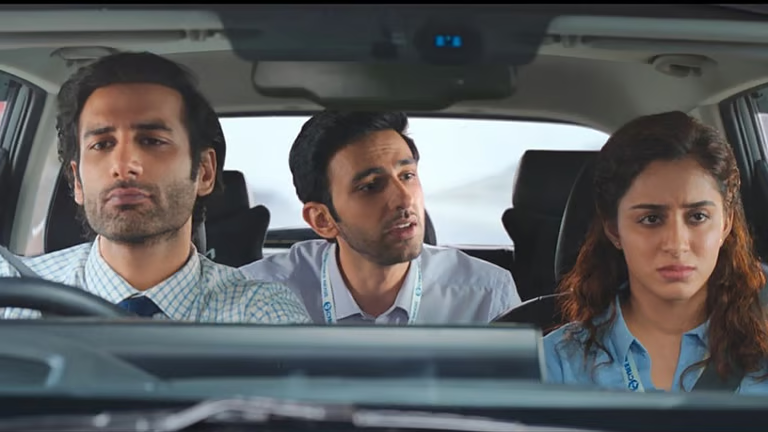
There is alleged evolution: the three flatmate-buddies in Gurgaon are two men and one woman now, and the movie is shot like an extended music video with a bit of story thrown in. PPDB begins with the three corporate-slave protagonists — Vedant (Kunal Aryan Vaid), Gautam (Sparsh Walia) and Shivie (Sargun Luthra) — who decide to attend their high-school reunion and woo their first loves because they see a broken one-sided lover (a Rajkummar Rao cameo) at a wedding.
The reunion happens at a Dehradun campus that looks like a giant Lokhandwala coffee shop. Vedant sets his sights on former first-bencher Simran (Sakshi Vaidya); Gautam woos the former mean-girl Gehna (Alisha Chopra); and Shivie goes all weak-kneed for bearded playboy Karan (Thushar Chhibber). The setting is every man’s fantasy of nostalgic weekends where they show up and impress former bullies with their credentials.
Related News



Three Tracks, One Problem
Vedant and Simran become the primary track: the serious no-means-yes love story that aspires to be the Shah Rukh Khan and Ranbir Kapoor starrers of yore. She is engaged, they flirt, but he aims to charm her with lines like “a relationship without pyaar is like a contractual freelance job; a relationship with pyaar is a government job where you grow old and become each other’s pensions.” Freelancers have it hard enough in this economy, so ouch.
Gautam’s track with Gehna acts as comic relief (shadowing the Kartik Aaryan arc in Pyaar Ka Punchnama); the boy gets more than he bargained for when Gehna turns out to be a clingy and manipulative sociopath. This may or may not involve a sex video and “funny” emotional blackmail. Three male writers, if you’re wondering.
Finally, Shivie’s track is given the stepchild treatment. Her strategy, as the only woman here, is simple: she transforms from a loose t-shirt-wearing foul-mouthed tomboy to a dancing siren to win over her hunk. That’s all she keeps doing. Rinse, makeover, repeat.
The Verdict
The film goes to great lengths to keep everyone decked up and pretty so that the performances are camouflaged. Most of the first half is the reunion; most of the second half gatecrashes a wealthy wedding weekend. The target audience is clear: the female characters are crazy or confused, and the men are sad or funny. Even the worst man of the lot is allowed to redeem himself.
It’s 2026, and this shtick is meant to tickle the hearts of several Indian romeos who send laugh-emojis on sexist marriage jokes. Even if you take out this dimension, there is a huge gap between what the film thinks it looks like and what it really is. The vanity in the mirror is a coping mechanism for a recycled lack of substance.
When in doubt, a character slips in a “ch*tiya” or two to bring out the giggles; when in more doubt, the movie calls itself out for romanticising filmy-tragic tropes. It’s all so dated that a homophobic gag is used to break the tension at some point. If they dig deep enough, archaeologists might unearth the fossilised remains of buried Hindi comedies from the 1990s that were at least a product of their time.