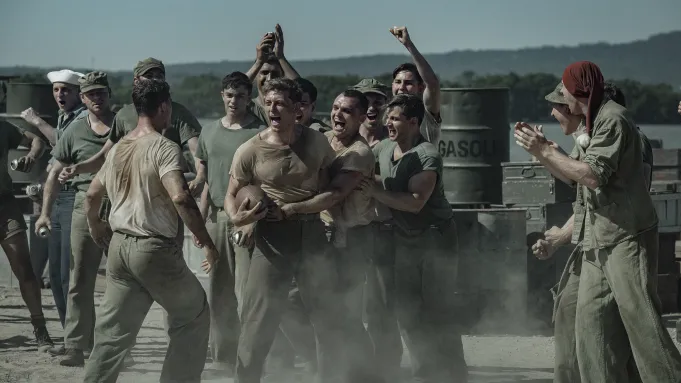
Los Angeles: Peter Berg’s new World War II drama for Netflix, The Mosquito Bowl, sets the tone right away with a famous Herbert Hoover quote: “Older men declare war. But it is youth that must fight and die. And it is youth who must inherit the tribulation, the sorrow, and the triumphs that are the aftermath of war.”
It is a statement eternal in its truth and devastating in its poignancy — and also, as the review notes, the theme of more or less every single war movie ever made. It would take some really sharp and distinctive execution to make it feel fresh again, and as admirable as The Mosquito Bowl often is in its craft, its storytelling falls well short of that bar .
The Premise
Adapted from Buzz Bissinger’s book of the same title (whose Friday Night Lights also spawned a Berg film), the film leads up to a legendary football game played between two Marine divisions stationed at Guadalcanal on Christmas Eve in 1944. One would expect the sports angle to add a welcome new spin on the usual war-drama storylines — and it does, though not nearly as much as you’re probably guessing, given how little of the 126-minute runtime the match actually takes up .
Its leads are a quartet of elite college football players who joined the Marines after Pearl Harbor, played by Nicholas Galitzine as thoughtful Brown alum John McLaughry; Ray Nicholson as charming Purdue alum Tony Butkovich; Tom Francis and Bill Skarsgard as anxious David Schreiner and wild Bob Bauman, both Wisconsin graduates .



Well-Trodden Territory
If the Hoover epigraph suggests a well-trodden path, the rest of the film confirms it has no intention of straying from it. The central themes are all ones you could guess from the logline alone: war forges unbreakable bonds of brotherhood; war makes men out of boys but destroys their minds and bodies; war is hell, as opposed to football, which represents youthful idealism — except that football is also a little bit like war if you think about it. “The Marine Corps is the greatest offensive line in the history of football,” one character declares .
The Saving Grace
The film’s great saving grace — the thing that might nevertheless make it worthwhile for people who simply enjoy war movies — are its technical elements. Combat sequences, set in the Pacific theater and filmed in Australia, look expansive and authentic, weaving around hundreds of soldiers running and shouting and shooting at once .
Berg, working with DP Jacques Jouffret, favors close shots that force us to experience battle much like the heroes do: as confusing, terrifying bursts of mayhem. Pinned in place by machine guns thundering all around, we watch in horror as a friend gets struck down mid-conversation, or flamethrowers wave wildly in the periphery. But that’s often all we get — other soldiers, friendlies and enemies alike, are glimpsed through trees or plumes of smoke. Updates get passed around like rumors. What lurks over the next ridge is anyone’s guess .
As the minutes stretch on, it starts to seem that The Mosquito Bowl is primarily interested in showing off how skilled Berg and his team are at producing action set pieces — be they battle, boot camp or football — and only secondarily in the people caught within them .
The Verdict
The review concludes that the film looks good but says little. Its technical craft is undeniable, but the storytelling never rises to meet it.