Mumbai: There is very little joy in watching a Bollywood spy comedy these days. You’re always on high alert. The suspense stems from the anticipation of exactly when the movie will break. You know the drill: spoofy first half, serious second half. Udta Teer, starring Ayushmann Khurrana, obediently follows these beats — and in doing so, sabotages its own cheeky premise.
The Ingenious One-Liner
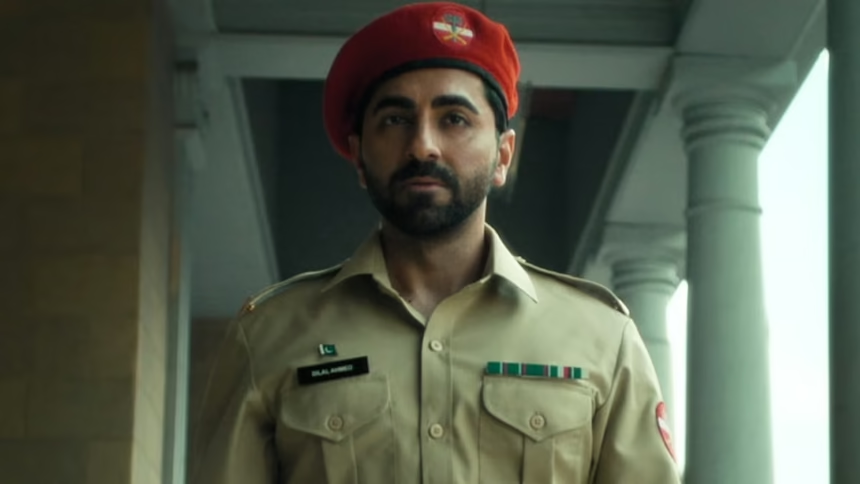
The setup is so simple that it’s ingenious: an undercover Pakistani spy (Khurrana) working as an Indian counter-terrorism agent gets amnesia in an accident and starts to believe he’s actually Indian. Bilal, whose cover is Vikrant, thinks his cover is real. On paper, it’s amusing enough — perhaps it was only a matter of time before slapstick mistaken-identity and memory-loss gags were applied to national identity.
They fly thick and fast in the first half. The movie is so loose-limbed here that you wonder if it’s taking the entire genre to the cleaners. You convince yourself that perhaps it turns both Indian jingoism and Pakistan-bashing into twin punchlines.
The First Half’s Cheek
There’s an extended gag featuring a sporting Rahul Bose as Vikrant’s intense boss that belongs to the Housefull franchise; paralysis is a tasteless joke in 2026, but there’s something cheeky about this particular actor being so effective in the role. There are at least two more undercover ISI agents in India, and their exasperation at seeing Bilal forget his allegiances is milked to the last drop. Suhail Nayyar comes full circle as one of them, after standing out as an undercover R&AW officer in the series Saare Jahan Se Accha.



Sara Ali Khan plays Vikrant’s wife who has no problem rekindling their broken marriage after he loses his memory — which would be creepy if not for Khan’s ability to look like she’s acting in another movie altogether.
The Inevitable Turn
Two recent movies come to mind when Udta Teer‘s inevitable turn comes: the Kunal Kemmu-led spy comedy Vibe, which switched to slick-action mode simply to showcase its craft, and Alpha, the YRF spy actioner that switched ideologies midway to fit the current landscape. This film is guilty of the same thing.
You can tell that it reverse-engineers its intent, almost as an apology for daring to be irreverent about the holy cross-border conflict. Everyone’s funny bone goes for a toss: the Pakistanis who were playing the fool abruptly become sinister, the Indians become heroic, the flag becomes the protagonist, and saffron floods the screen. At one point, four terrorists are captured to the score of a devotional anthem; at another, a song called ‘Jai Hind’ is staged as a humiliation ritual. Most scenes in the second half unfold like they’re written — and rewritten — by different writers given separate briefs.
The Film Becomes What It Parodied
This is when the viewer realises the film becomes the very entity it appeared to parody. All the Muslim cartoon-baddies in the first half start to reflect the very demonisation you thought the film was spoofing. The mixed signals are grating. It reaches a stage where, forget the audience, even the movie doesn’t know if it’s being unserious or deadpan.
Udta Teer enters an endless loop of defeating itself, flitting between an Incredible India spot and an inverted Dhurandhar template. Like its hero, it keeps infiltrating its own identity. The inception of plot twists and personas is a sight to behold: the Pakistani pretends to be an Indian who pretends to be a Pakistani who pretends to be an Indian pretending to be a Pakistani who… it doesn’t matter.
The Verdict
The man had to lose his memory to become a patriot, but it’s only patriotism if it’s for the “right” side. Watching Udta Teer is like hanging out with the class clown whose problematic takes you tolerate because he’s witty — until he shows his true colours. It’s not that you didn’t see it coming, but it’s normal to feel a little duped by films that promise humanist undertones.
A decade ago, this might have been a playful send-up of a thriller like Raazi. But today it’s an agitated tribute to the low-hanging fruits of tricolour trees. Gone are the days of Tere Bin Laden, Happy Bhag Jayegi, or even Bangistan. Satire is no longer the sibling of dissent; it’s the stepchild of compliance.