For artists and entertainment brands, merchandise is no longer an afterthought. It’s a measure of loyalty and relevance, with industry insiders betting on a $10-billion fandom economy by 2028
When the New York Knicks won the NBA championship in June, fans poured into the streets wearing the same jerseys and chanting the same slogans. A few years earlier, Taylor Swift’s Eras Tour had people exchanging friendship bracelets across the world, while closer home, crowds still gather outside Amitabh Bachchan’s residence for a glimpse of the superstar. These are stories of extraordinary artists and entertainers—but also of the communities that rally around them.
For decades, fandom was viewed as a by-product of popularity, and merchandise was little more than a souvenir picked up after a concert. But today, it’s increasingly becoming an industry in its own right, influencing everything from touring decisions and brand partnerships to whether international acts choose to perform in markets like India.
“It’s not just about having merch, but about building a business around fandom itself,” says Jinal Ajmera, co-founder of MyFandom.


Design Reigns Supreme
Bhavik Vora, founder of C.O.R.E., India’s first large-scale pop-culture festival, has spent two decades in the merchandising business. “When we started, it was largely centred around kids’ entertainment channels like Cartoon Network and Pogo, with products such as toys and apparel,” he says. “Then came the internet, e-commerce and OTT boom, and everything changed.”
But what has truly propelled the fandom economy, Bhavik says, is the rise of experiences. And merchandise completes this loop. It gives fans a tangible connection to the characters, stories and artists they love, particularly when tied to live experiences such as concerts, conventions and festivals.
“Music merchandise is currently the most sought-after category,” he says. The surge of international artists performing in India has fuelled that demand, and he now receives several calls a day from fans looking to buy merchandise linked to their favourite artists.
The Artist’s Perspective
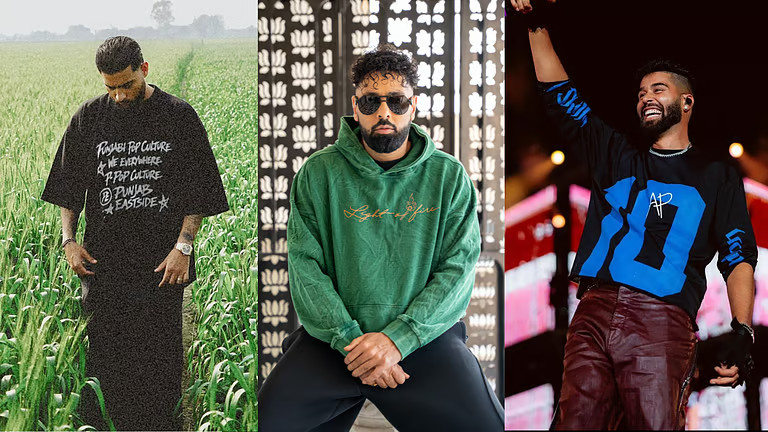
Rapper Badshah, who launched his streetwear brand Badfit in 2017, is one of the few Indian artists genuinely invested in building a merchandise business. “You can’t delegate your identity,” he says.
For Badshah, artists need to approach merchandising with the same rigour they bring to the studio. That means being involved in everything from fabrics and silhouettes to colour palettes and graphic design.
“When your merchandise holds legitimate artistic and sartorial value, it commands respect far beyond the music industry,” he says. “If you treat it as an afterthought by just slapping a logo on a generic, low-quality garment, your audience will sense the lack of authenticity immediately.”
The Design Challenge
Bhavik agrees that design is often the difference between merchandise that sells and merchandise that doesn’t. “The assets you use for a billboard are very different from what works on a T-shirt or backpack. Merchandise shouldn’t look like advertising,” he says. “The product itself should be brand-agnostic. It should be so cool that even if you don’t know the brand, or didn’t like the movie, you’d still want to buy it.”
“If I’m being real, most merch in India doesn’t clear that bar yet,” admits Meet Gala, co-founder of SuperClan. He explains that the average fan today is shopping at international chains like Uniqlo and Zara, so they understand what ₹1,500 can get them.
The Business of Fandom
According to Jinal, what makes merch successful starts with the IP. Then comes relevance to the audience, the artist’s layer, product quality, and attention to detail. For Badshah, streaming numbers indicate reach, while merchandise sales reveal retention.
“A stream costs the listener minimal effort and zero financial sacrifice. Even a ticket sale can simply mean curiosity or a desire for a night out,” he says. “But when a fan buys merchandise, they’re investing capital into your identity; that’s a direct metric of emotional equity.”
He continues, “If you have millions of streams but nobody’s buying your merch, you have traction, not community. You have a hit song, but you haven’t built a culture.”
Meet agrees. Merchandise sales are the most honest number in the room; one can’t fake it or buy it. It’s the number that tells you who’s likely to still matter five years from now.
The Future of Indian Merch
“I hate saying this, but we still have an aspiration for global artists, whether it’s Hollywood, music, or sports,” says Bhavik. He points to Indian cinema and cricket—arguably the country’s strongest cultural forces—as proof that demand exists. The challenge, he says, is design.
For India’s merchandising industry, the next step may be turning local stories into global cultural enterprises. “Japan owns manga. They don’t worry about what Hollywood is doing. They created their own category. If we can do the same with our mythology, folklore, and stories, it can travel across the world,” he says.
Vivek Ajmera, co-founder of MyFandom, says, “The [Indian] fandom economy is still in its nascent stage. We’re very bullish on it and look forward to 2028, when we see this becoming a $10 billion economy.”