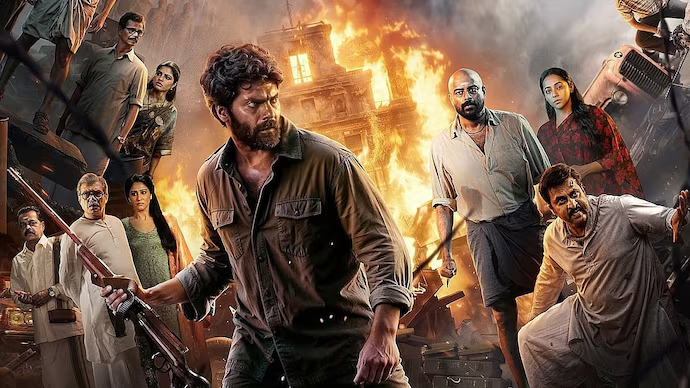
Ambitious themes of systemic oppression get buried under a predictable revenge saga and an overstuffed screenplay.
Jiyen Krishnakumar’s Ananthan Kaadu, starring Arya and written by Murali Gopy, arrives with the weight of a significant political drama. Set against the backdrop of the Sri Lankan Civil War and 1990s Kerala politics, the film aims to explore themes of identity, displacement, and systemic oppression. While it boasts a strong setting and some compelling performances, it ultimately settles into a familiar and predictable revenge narrative.
A Promising Start Lost in Translation
The film opens with a harrowing sequence depicting the atrocities committed against Tamil civilians during the Sri Lankan conflict. This sets the stage for a story that seems to promise a deep examination of power and its consequences. The narrative follows Vetrivel Kumaran (Arya), an Eelam Tamil revolutionary who escapes to Kerala after his family is killed, and seeks refuge with a group of former gangsters in Thiruvananthapuram led by Krishnankutty (Indrans). This group, which includes Thankaraj (Murali Gopy), Murali (Dev Mohan), and Jackson (Appani Sarath), once carried out political killings for the local Chief Minister (Vijayaraghavan) but now struggle to lead a peaceful life.
The film’s initial stretches, which focus on the political intrigue and the brotherhood between the gang members, have been praised for their confidence and engagement. The opening hour patiently builds its world, allowing the political landscape to feel like a living force. However, this ambition is short-lived. As the film progresses, it loses its grip on its complex themes and devolves into a standard revenge drama, a criticism echoed across several reviews.



Performances and Technical Aspects
Arya delivers one of his more restrained performances in recent years, effectively portraying a man driven by quiet conviction and exceptional combat skills. He excels in action sequences but is less convincing in emotionally demanding scenes. Indrans emerges as a standout, bringing a unique brand of authority to the role of the gang leader, while Murali Gopy balances ideology with vulnerability in his performance. The supporting cast, including Dev Mohan, Nikhila Vimal, and Santhy Balachandran, perform their parts sincerely, but many of their characters are underwritten, with the female roles particularly lacking depth.
On the technical front, the film is visually grand, with Jiyen Krishnakumar demonstrating his ability to handle a large canvas. B. Ajaneesh Loknath’s background score adds intensity to key moments, though it is often described as too loud for its own good. However, the editing has been a major point of contention. Critics have slammed the film’s hyperactive editing, which uses constant cuts and camera angle changes, diminishing the impact of crucial scenes and, in some cases, causing a sense of nausea.
The Verdict
Ananthan Kaadu is a film caught between its ambition to be a meaningful political chronicle and its reliance on the formula of a commercial revenge potboiler. Its strongest moments lie in its political observations, but these are often diluted by a screenplay crowded with sub-plots and an execution that feels dated. While the sincerity of its ideas is palpable, the film struggles to translate them into a compelling and emotionally resonant cinematic experience. It may appeal to viewers interested in politically themed dramas, but for mainstream audiences, Ananthan Kaadu is likely to be a frustrating watch that promises more than it delivers.