Oscar-winning actor Russell Crowe has delivered a scathing verdict on the sequel to his 2000 classic Gladiator, stating that the film failed because it lost the “moral core” of the original and fundamentally misunderstood what made the first movie resonate with audiences.
In a recent interview, Crowe—who originated the iconic role of Maximus Decimus Meridius but did not appear in the sequel—offered his blunt assessment of the project, which was released to mixed reviews and underperformed at the box office .
The original’s moral core
Crowe argued that the original Gladiator succeeded because it was grounded in a clear moral framework. “The original worked because it had a very strong moral core,” he said. “It was about something. It was about a man who lost everything and wanted to be reunited with his family. That’s it. That’s the whole story. Everything else is just window dressing.”
He suggested that the sequel’s creative team, including director Ridley Scott, failed to grasp this essential truth. “They tried to recreate the spectacle but forgot why the spectacle mattered,” Crowe added.

Director Ridley Scott’s response
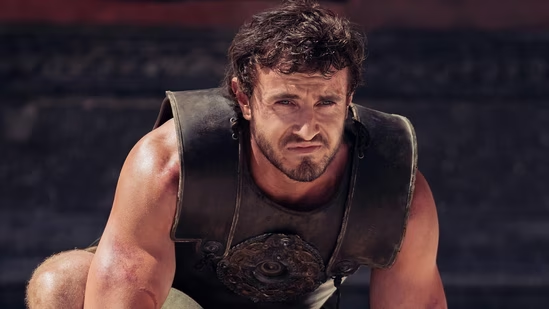
Director Ridley Scott has consistently defended the sequel. In January, he addressed the criticism head-on, telling the Daily Express that Crowe’s comments were “irrelevant.” Scott argued that the new film had expanded the universe and introduced compelling characters in Paul Mescal’s Lucius and Denzel Washington’s Macrinus.
“It’s completely irrelevant,” Scott said of Crowe’s opinion. “It’s interesting what he says, but he hasn’t even seen the film, which makes his comments completely irrelevant to the film. It’s not necessary. The film is very good, that’s the main thing.”
Scott also stated that he had to explain to Crowe that he was “not in the film,” a conversation he described as necessary to move forward with the sequel .
Why Gladiator II struggled
Gladiator II, released to mixed reviews and underwhelming box office numbers, faced several challenges. Critics noted that while the film had a grander scale, it lacked the emotional resonance of the original. With an estimated budget of $250 million, the film struggled to recoup its investment, with some analysts suggesting it needed to earn upwards of $500 million to break even .
The ‘cinematic universe’ trap
Crowe’s critique touches on a broader concern in Hollywood: the tendency to turn singular, character-driven stories into franchises. “Everybody wants their own cinematic universe now,” he said. “But you can’t build a universe unless you have a story that makes people want to visit that universe.”
The actor, who had famously clashed with Scott during the filming of the original, said he waited for the filmmakers to ask for his input on the sequel, but they never did. “I just had to accept it,” Crowe said. “But I knew the first one worked for a reason. And I knew when I read the script for the second one… well, you can see the results.”